Many patients hear the word “endoscopy” and feel immediately anxious. However, endoscopy in Varanasi is one of the safest, most commonly performed diagnostic procedures in gastroenterology today — and in many cases, it is the only reliable way to find out exactly what is causing persistent stomach pain, chronic acidity, or unexplained vomiting.
Most people delay getting an endoscopy because they are unsure whether their symptoms actually warrant it. Unfortunately, this delay often means that treatable conditions go undiagnosed for months or years. In fact, an endoscopy takes less than 15 minutes, causes minimal discomfort, and delivers answers that no blood test or ultrasound can provide.
This guide explains what an endoscopy is, when doctors recommend it, and what you can realistically expect from the procedure.
What Is an Endoscopy?
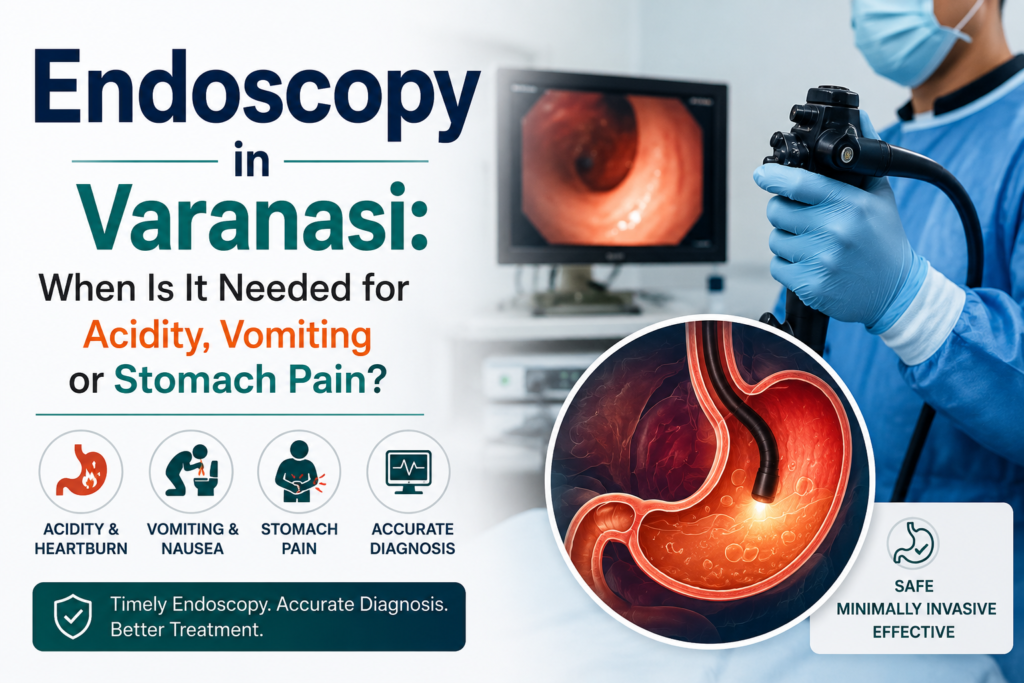
An endoscopy is a procedure in which a doctor passes a thin, flexible tube called an endoscope through your mouth and into the digestive tract. A tiny camera at the tip of the tube transmits live images to a monitor, allowing the doctor to visually examine the inner lining of the oesophagus, stomach, and upper part of the small intestine.
This type of endoscopy — called an Upper GI Endoscopy or OGD Scopy — is the most common form performed in gastroenterology clinics across India. Additionally, doctors can pass small instruments through the endoscope to take tissue samples (biopsy), treat bleeding, or remove polyps — all during the same procedure.
The procedure typically takes 10 to 20 minutes. Moreover, doctors usually perform it under mild sedation, so most patients feel little to no discomfort throughout.
When Do Doctors Recommend an Endoscopy?
Doctors do not recommend an endoscopy for occasional or mild digestive symptoms. However, certain symptoms strongly indicate that a visual examination of the digestive tract is necessary. Here are the most common situations where an endoscopy becomes essential.
1. Chronic Acidity or GERD That Does Not Respond to Medication
Daily heartburn or acid reflux that persists despite taking antacids or prescribed medication is one of the most important reasons doctors recommend an endoscopy. Chronic acid exposure gradually damages the oesophageal lining — a condition called oesophagitis. Furthermore, in some patients, this damage progresses to Barrett’s Oesophagus, a pre-cancerous change that requires regular monitoring.
An endoscopy is the only way to assess the extent of this damage accurately. Consequently, doctors strongly recommend it for anyone with GERD symptoms lasting more than four to six weeks despite treatment.
2. Difficulty Swallowing Food or Liquids
Feeling like food is getting stuck in the throat or chest while swallowing — a symptom called dysphagia — always warrants an endoscopy. This symptom can indicate oesophageal narrowing, inflammation, a growth, or structural damage from chronic acid reflux. Additionally, early detection of any abnormality in this area significantly improves treatment outcomes.
3. Persistent Nausea or Vomiting
Occasional nausea after a heavy meal is perfectly normal. However, nausea or vomiting that occurs regularly — particularly in the morning, after meals, or without an obvious trigger — often signals an underlying condition affecting the stomach. Moreover, vomiting that contains blood or looks like coffee grounds requires an emergency endoscopy without any delay.
4. Unexplained Stomach Pain or Upper Abdominal Discomfort
A burning, gnawing, or cramping pain in the upper abdomen — especially one that occurs between meals, wakes you at night, or has persisted for more than two to three weeks — is a strong indication for endoscopy. In many cases, this pattern of pain points to a peptic ulcer, gastritis, or H. pylori infection. Consequently, treating the underlying cause requires identifying it first.
5. Blood in Stool or Black-Coloured Stools
Black, tarry stools almost always indicate bleeding from the upper digestive tract — typically the stomach or small intestine. Bright red blood in stool may suggest bleeding lower down. Either way, an endoscopy is the most reliable tool for locating the source of bleeding and treating it immediately. Therefore, doctors treat this symptom as urgent and schedule endoscopy without delay.
6. Unexplained Weight Loss Alongside Digestive Symptoms
Losing weight without trying — particularly when accompanied by any of the symptoms above — is a combination that gastroenterologists take very seriously. Additionally, loss of appetite combined with upper abdominal discomfort requires a thorough investigation to rule out serious underlying conditions.
7. Suspected H. Pylori Infection or Stomach Ulcer
H. pylori is a bacterial infection extremely common in India, affecting a large proportion of the adult population. It causes chronic gastritis, peptic ulcers, and persistent bloating. While breath tests can detect the infection, an endoscopy allows the doctor to assess the degree of stomach lining damage directly and take a biopsy for confirmation. Furthermore, this information guides more precise and effective treatment.
8. Before or After Stomach Surgery
Doctors routinely recommend an endoscopy before certain abdominal surgeries to assess the condition of the digestive tract. Similarly, after stomach surgery, an endoscopy helps monitor healing and detect any complications at an early stage.
What Conditions Does an Endoscopy Detect?
A single upper GI endoscopy procedure can identify a wide range of conditions, including:
| Condition | What the Endoscopy Reveals |
|---|---|
| GERD and Oesophagitis | Acid damage to the oesophageal lining |
| Barrett’s Oesophagus | Pre-cancerous changes in the food pipe lining |
| Peptic Ulcer | Open sores in the stomach or upper intestine |
| Gastritis | Inflammation of the stomach lining |
| H. Pylori Infection | Confirmed via biopsy during endoscopy |
| Hiatal Hernia | Part of stomach protruding into the chest |
| Oesophageal Stricture | Narrowing of the food pipe |
| Stomach Polyps | Abnormal growths requiring removal or monitoring |
| Gastrointestinal Bleeding | Source identified and treated in the same procedure |
What Should You Expect During an Endoscopy?
Understanding the procedure in advance helps reduce anxiety considerably. Here is what typically happens:
Before the procedure: Your doctor will ask you to fast for six to eight hours beforehand. This ensures the stomach is empty, giving the camera a clear view. Additionally, inform your doctor about any medications you currently take — particularly blood thinners.
During the procedure: A nurse will spray a local anaesthetic on your throat to reduce the gag reflex. Moreover, a mild sedative is usually given intravenously to help you relax. The endoscope passes gently through the mouth — most patients report feeling mild pressure rather than pain. The entire procedure takes between 10 and 20 minutes.
After the procedure: You will rest in a recovery area for 30 to 60 minutes while the sedation wears off. Because of the sedative, bring someone to drive you home. Furthermore, a mild sore throat for a day or two is completely normal. Your doctor discusses findings with you immediately after the procedure — or once biopsy results return, if samples were taken.
Is Endoscopy Safe?
Yes — upper GI endoscopy is one of the safest procedures in modern medicine. Serious complications are extremely rare. Minor side effects such as a mild sore throat, temporary bloating, or brief nausea are the most common experiences patients report.
However, as with any medical procedure, your doctor will discuss specific risks with you beforehand based on your individual health profile. Overall, the diagnostic benefit of an endoscopy far outweighs any minimal risk in the vast majority of patients.
How Much Does an Endoscopy Cost in Varanasi?
The cost of an upper GI endoscopy in Varanasi typically ranges from ₹2,000 to ₹5,000, depending on the clinic, the type of endoscopy required, and whether sedation or biopsy is included.
At Samarpan Gastro and Liver Clinic, Dr. Shekhar Puri performs endoscopy using advanced, modern equipment with full sedation support — ensuring an accurate result and a comfortable experience for every patient. Additionally, all findings are explained clearly during the consultation following the procedure.
Do Not Delay — Early Diagnosis Makes All the Difference
Persistent acidity, unexplained vomiting, stomach pain, or any of the warning signs above deserve a proper diagnosis — not just another antacid.
According to the Indian Society of Gastroenterology, early endoscopic evaluation of persistent upper GI symptoms significantly reduces the risk of serious complications and improves long-term treatment outcomes. In other words, getting an endoscopy early is always a smarter choice than waiting for symptoms to worsen.
Dr. Shekhar Puri at Samarpan Gastro and Liver Clinic, Varanasi specialises in advanced endoscopy and the complete diagnosis and treatment of stomach, digestive, and liver conditions. With years of specialist experience and a patient-centred approach, Dr. Puri is the trusted choice for endoscopy in Varanasi.
Book your appointment today via WhatsApp — because your symptoms deserve a real answer, not just temporary relief.
⚠️ Medical Disclaimer: This blog is for general informational purposes only and does not constitute medical advice. Always consult a qualified doctor for diagnosis and personalised treatment.
