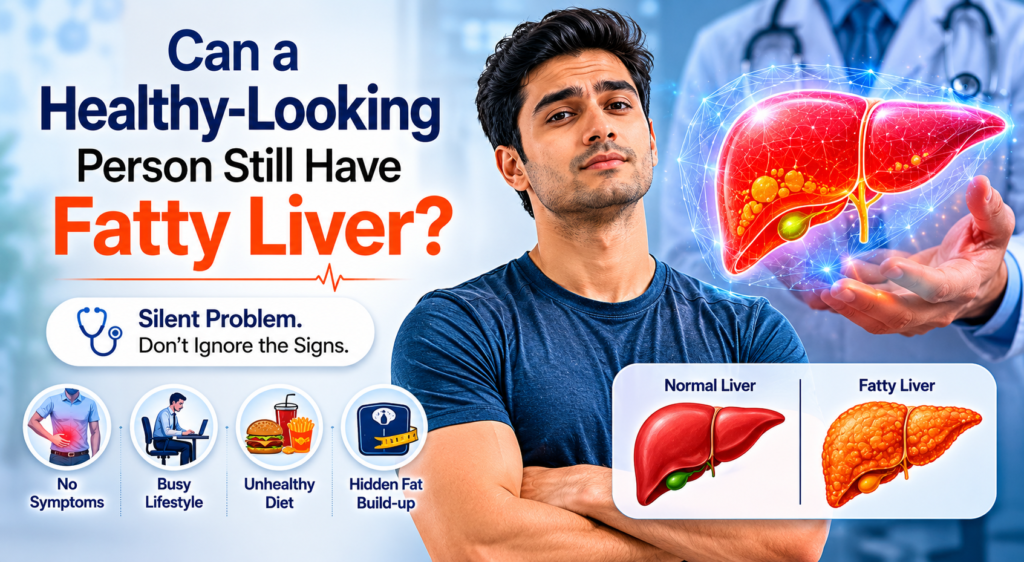
Yes — and this is one of the most important liver health facts that most Indians are completely unaware of. A healthy-looking person can absolutely have fatty liver — and in many cases, they have no symptoms, no visible weight problem, and no history of alcohol consumption.
Fatty liver disease does not discriminate based on appearance. Thousands of young Indians who look fit, maintain a reasonable weight, and live seemingly healthy lives are walking around with significant fat accumulation in their liver — entirely unaware of it. Moreover, without early detection and intervention, this silent condition can progress to serious liver damage over time.
This guide explains exactly why appearance is a poor indicator of liver health, who is truly at risk, and what steps a healthy-looking person should take to protect their liver.
Why Appearance Does Not Reflect Liver Health
Most people associate fatty liver with obesity. This assumption is understandable — but dangerously misleading. Fatty liver develops inside the liver cells, and no amount of looking at someone from the outside reveals what is happening at a cellular level inside their body.
Furthermore, Indians are genetically predisposed to a pattern called Lean NAFLD — Non-Alcoholic Fatty Liver Disease in people with a normal or near-normal body weight. Research consistently shows that South Asians develop fatty liver at lower body weights and lower BMI values than Western populations. Consequently, the standard visual cues that might signal fatty liver risk in other ethnic groups simply do not apply to Indians in the same way.
The liver is a silent organ. It sends no pain signals in its early stages of distress. Additionally, it compensates remarkably well for a long time before function begins to visibly deteriorate. By the time outward symptoms appear, significant internal damage has often already occurred.
What Is Lean Fatty Liver Disease?
Lean NAFLD refers specifically to fatty liver disease in individuals with a Body Mass Index (BMI) below 25 — the standard threshold for a healthy weight. However, BMI is a deeply imperfect tool for assessing metabolic health, particularly in Indians.
A person with a normal BMI can still carry dangerous amounts of visceral fat — fat stored around and inside internal organs rather than under the skin. Visceral fat is metabolically active. It releases fatty acids and inflammatory signals directly into the liver, driving fat accumulation regardless of what the person looks like.
Moreover, research published in leading gastroenterology journals estimates that lean NAFLD accounts for approximately 10 to 20 percent of all NAFLD cases globally — and the proportion is even higher among Indians due to genetic susceptibility.
7 Reasons a Healthy-Looking Person Can Develop Fatty Liver
1. Visceral Fat Hidden Beneath a Normal Exterior
As discussed above, visceral fat — stored around internal organs — does not appear as visible belly fat in all cases. Consequently, a person can have a flat stomach and still carry significant amounts of fat around the liver and other abdominal organs.
Indian bodies tend to store fat viscerally at lower overall body weights. Therefore, a young Indian professional who looks slim by any conventional measure may still carry enough visceral fat to trigger significant liver fat accumulation.
2. High Fructose and Refined Carbohydrate Diet
The liver is the primary site for fructose metabolism in the body. When someone regularly consumes soft drinks, packaged fruit juices, sugary teas, or ultra-processed snacks — the liver converts excess fructose directly into fat. Furthermore, refined carbohydrates like white rice, maida, and instant noodles spike blood sugar rapidly, driving insulin production and fat storage in the liver.
A person can follow this dietary pattern while maintaining a healthy weight through calorie balance — yet still be accumulating dangerous fat in their liver cells simultaneously.
3. Insulin Resistance Without Obvious Diabetes
Insulin resistance — where body cells stop responding efficiently to insulin — directly promotes liver fat accumulation. Moreover, insulin resistance often develops silently for years before blood sugar levels rise high enough to trigger a diabetes diagnosis.
A healthy-looking young Indian can have significant insulin resistance — confirmed only by specific blood tests like fasting insulin, HbA1c, or an OGTT — while appearing perfectly healthy and maintaining a normal weight.
4. Sedentary Lifestyle Despite a Normal Weight
Physical inactivity reduces the body’s ability to oxidise (burn) fat. Consequently, even in people who are not overweight, a desk-based lifestyle with minimal movement throughout the day creates conditions where liver fat accumulates progressively.
Additionally, studies consistently show that sedentary behaviour — measured in hours of sitting per day — is an independent risk factor for fatty liver, separate from overall body weight or calorie intake.
5. Genetic Susceptibility Unique to Indians
The PNPLA3 gene variant — which dramatically increases susceptibility to NAFLD — is found at higher prevalence in South Asian populations than in most other ethnic groups. Furthermore, this genetic factor means that Indian individuals accumulate liver fat more readily than others under the same dietary and lifestyle conditions.
Therefore, a young Indian person with this gene variant, a desk job, and a diet high in refined carbohydrates can develop significant fatty liver despite appearing entirely healthy by conventional standards.
6. Chronic Stress and Poor Sleep
Elevated cortisol from chronic stress promotes insulin resistance and increases visceral fat storage — both of which directly contribute to fatty liver. Moreover, consistently sleeping less than six hours per night is independently associated with higher liver fat content in multiple large-scale studies.
Young Indian professionals dealing with work pressure, financial stress, and disrupted sleep schedules face these risks daily — often without connecting them to their liver health.
7. Crash Dieting and Irregular Eating Patterns
Paradoxically, extreme calorie restriction and crash dieting can worsen fatty liver in the short term. When the body receives insufficient dietary energy, it mobilises fat from other tissues and channels it through the liver. Consequently, the liver can actually accumulate more fat during a crash diet before improvement begins.
Additionally, irregular meal timing — skipping breakfast, eating a large meal very late at night — disrupts circadian metabolic rhythms in ways that promote liver fat accumulation, particularly in people already genetically predisposed to NAFLD.
What Are the Signs to Watch For?
Because fatty liver is largely silent, most healthy-looking people with the condition experience few or no obvious symptoms. However, some subtle early signs include:
- Persistent, unexplained fatigue — the most commonly reported symptom
- Mild heaviness or dull ache in the upper right abdomen, below the rib cage
- Bloating after meals — particularly after high-fat or high-carbohydrate foods
- Darkening of skin around the neck, armpits, or knuckles — a visible sign of insulin resistance called acanthosis nigricans
- Mild nausea without an obvious dietary cause
- Feeling full quickly after small amounts of food
Furthermore, if any of these symptoms persist for more than two to three weeks — even in someone who appears healthy — a liver assessment is strongly recommended rather than dismissed.
Which Tests Confirm Fatty Liver in a Healthy-Looking Person?
Because appearance provides no reliable indication of liver health, the only way to confirm or rule out fatty liver is through targeted diagnostic testing.
Abdominal Ultrasound
The most accessible and commonly used tool for detecting fatty liver. An ultrasound identifies fat accumulation in the liver, assesses liver size, and evaluates overall liver texture — all non-invasively and without radiation. Moreover, it provides results within minutes of the scan.
Liver Function Test (LFT)
A blood test measuring liver enzymes — particularly ALT and AST. Elevated levels indicate inflammation or damage. However, in early lean NAFLD, enzyme levels can sometimes appear normal — making ultrasound equally essential rather than optional.
Fasting Blood Sugar and HbA1c
Since insulin resistance closely links to fatty liver, blood sugar testing forms a critical part of any liver health assessment. An HbA1c test reveals average blood sugar over the past two to three months — providing far more insight than a single fasting glucose reading.
Lipid Profile
Elevated triglycerides and low HDL cholesterol are strongly associated with NAFLD. Consequently, a lipid profile is routinely included in any comprehensive fatty liver workup.
Fasting Insulin Level
While not always routine, a fasting insulin test directly measures insulin resistance — the key metabolic driver of lean NAFLD — in people whose blood sugar levels still appear normal.
Frequently Asked Questions
Can a slim person have fatty liver? Yes — absolutely. Lean NAFLD is well-documented in people with a normal BMI, particularly among Indians. Visceral fat, insulin resistance, genetic susceptibility, poor diet, and sedentary behaviour all cause fatty liver independently of body weight or external appearance.
Can fatty liver occur without any symptoms? Yes. Most people with early-stage fatty liver — including healthy-looking individuals — experience no noticeable symptoms at all. This is precisely why routine testing is essential rather than waiting for symptoms to develop.
How do I find out if I have fatty liver if I look healthy? The most reliable approach is an abdominal ultrasound combined with a Liver Function Test (LFT), fasting blood sugar, HbA1c, and lipid profile. These tests together provide a comprehensive picture of liver health regardless of how a person appears externally.
Is fatty liver in a healthy-looking person reversible? Yes — when detected early. Simple fatty liver responds well to dietary changes, regular exercise, stress management, and improved sleep. However, if it progresses to NASH or cirrhosis without intervention, reversal becomes significantly more difficult and may require ongoing medical management.
Which doctor should I see for fatty liver in Varanasi? A gastroenterologist or liver specialist is the right doctor to consult for fatty liver assessment and treatment. Dr. Shekhar Puri at Samarpan Gastro and Liver Clinic, Varanasi, specialises in fatty liver, liver cirrhosis, NAFLD, and all related digestive and liver conditions.
Consult Dr. Shekhar Puri — Varanasi’s Liver Specialist
Looking healthy is not the same as being healthy — particularly when it comes to your liver.
If you carry any of the risk factors discussed in this guide — a desk-based lifestyle, a diet high in refined carbohydrates, chronic stress, poor sleep, a family history of diabetes or liver disease, or simply have not had a liver health check in the past year — do not assume that looking healthy means your liver is healthy.
Dr. Shekhar Puri at Samarpan Gastro and Liver Clinic, Varanasi specialises in the diagnosis and treatment of fatty liver disease, NAFLD, NASH, liver cirrhosis, and all related digestive conditions. With advanced diagnostic tools and a patient-centred approach, Dr. Puri provides clear answers and effective, personalised treatment plans.
Book your appointment today via WhatsApp — because your liver deserves attention long before it starts complaining.
According to the American Association for the Study of Liver Diseases (AASLD), NAFLD in lean individuals carries the same risk of disease progression as in obese patients — making early detection equally critical regardless of body weight or appearance.
⚠️ Medical Disclaimer: This blog is for general informational purposes only and does not constitute medical advice. Always consult a qualified doctor for diagnosis and personalised treatment.
