
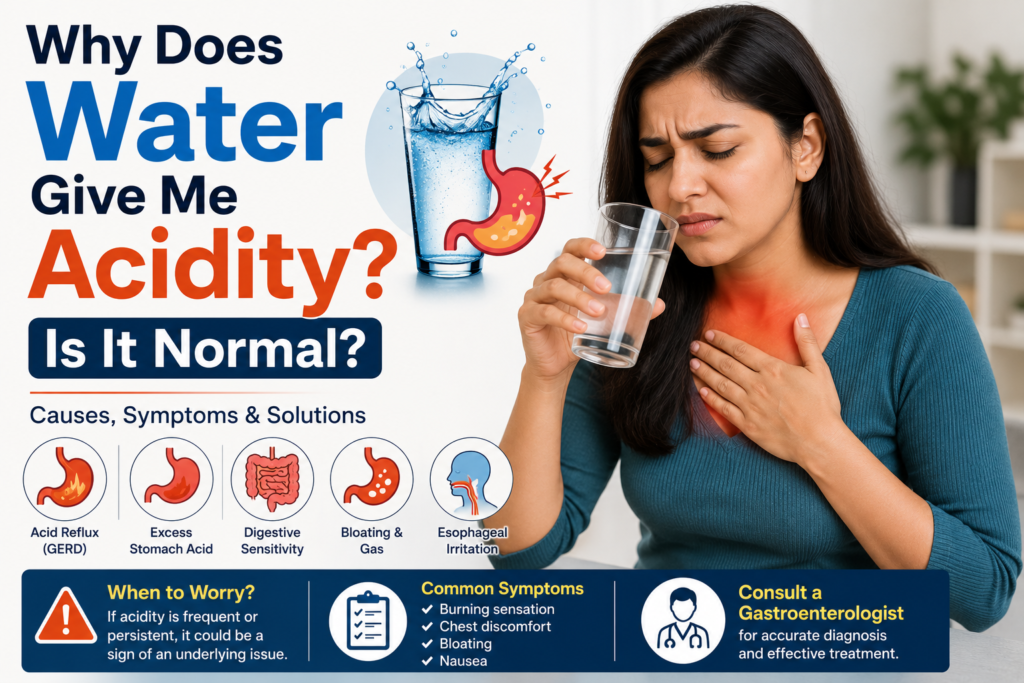
You drink a glass of plain water. Within minutes, you feel a burning sensation in your chest or throat. No food involved. Just water — and yet the acidity starts immediately.
This is one of the most confusing digestive experiences a person can have. Moreover, water giving you acidity feels counterintuitive — water is supposed to help, not hurt. Consequently, most people dismiss it or wonder whether they are imagining it.
You are not imagining it. Water gives some people acidity — and there are specific, identifiable reasons why. This guide explains all of them.
Water can trigger acidity when the stomach already contains excess acid. Drinking water dilutes this acid temporarily — but then the stomach produces more acid in response, creating a rebound effect. Moreover, gulping water quickly introduces air into the stomach — increasing pressure and triggering reflux. When water consistently gives you acidity, it usually indicates an underlying condition like GERD, gastritis, or a peptic ulcer — not simply a reaction to water itself. Patients experiencing persistent digestive symptoms can consult a gastroenterologist for proper evaluation and treatment.
Is It Normal for Water to Cause Acidity?
Occasional mild discomfort after drinking water on an empty stomach is relatively common — particularly in people with sensitive stomachs. However, consistent acidity every time you drink water is not normal.
Furthermore, water itself is pH-neutral — it should not cause acid production. When water consistently triggers burning or discomfort, the problem lies in the digestive system’s response — not in the water itself.
What Actually Happens When Water Triggers Acidity
Your stomach continuously produces acid. When water enters an already acidic stomach, it initially dilutes the acid — providing brief relief. However, the stomach then detects this dilution and stimulates further acid production to restore its normal acidic environment. Consequently, a rebound acid surge follows — producing the burning sensation you associate with drinking water.
Symptoms Checklist — Does This Sound Like You?
Check the symptoms that apply to your experience:
☐ Burning sensation in chest or throat after drinking water
☐ Acidity worse when drinking water on an empty stomach
☐ Gulping water quickly causes immediate discomfort
☐ Cold water triggers more acidity than warm water
☐ Carbonated water causes significantly more burning
☐ Acidity occurs regardless of whether you have eaten
☐ Water before bed causes nighttime heartburn
☐ Belching immediately after drinking water
☐ Nausea alongside the burning sensation from water
☐ Acidity persists for 30 minutes or more after drinking
If you checked 3 or more: Your symptoms suggest an underlying digestive condition rather than a normal reaction to water. Furthermore, seeing a gastroenterologist for proper evaluation is strongly recommended.
7 Reasons Water Gives You Acidity
1. GERD — The Most Common Underlying Cause
Gastroesophageal Reflux Disease is the most frequent reason water gives people acidity. In GERD, the lower oesophageal sphincter — the valve between the oesophagus and stomach — weakens or relaxes inappropriately.
When water enters the stomach, it increases gastric volume temporarily. Moreover, this increased volume creates upward pressure on the weakened sphincter — causing acid to reflux into the oesophagus. Consequently, even a small glass of water can trigger significant burning in someone with GERD.
Why GERD Gets Worse With Water on an Empty Stomach
An empty stomach concentrates acid more intensely than a stomach containing food. Furthermore, water entering this concentrated acid environment creates a rapid pH shift — triggering a stronger acid rebound response. Consequently, many GERD patients find that water causes most acidity in the morning — after hours of fasting overnight.
2. Gastritis — Inflamed Stomach Lining
Gastritis is inflammation of the stomach’s inner lining. An inflamed stomach lining is significantly more sensitive than a healthy one. Moreover, even neutral substances — including plain water — can irritate an already inflamed lining and trigger burning.
Furthermore, H. pylori bacterial infection is the most common cause of gastritis in India. This infection increases acid production significantly — making even small amounts of water painful when it contacts the sensitised stomach lining.
3. Peptic Ulcer Disease
A peptic ulcer is an open sore on the stomach lining or upper intestine. Water contacting an active ulcer can cause sharp, immediate pain or burning. Moreover, water temporarily dilutes acid around the ulcer — but the subsequent acid rebound worsens the irritation.
Furthermore, many patients with peptic ulcers report that water worsens their symptoms — particularly on an empty stomach in the morning. Consequently, water-triggered acidity combined with upper abdominal pain strongly suggests peptic ulcer as the underlying cause.
4. Swallowing Air While Drinking
Many people gulp water quickly — particularly when thirsty. Moreover, rapid gulping introduces significant amounts of air into the stomach simultaneously.
This swallowed air increases gastric pressure. Furthermore, elevated pressure pushes stomach contents — including acid — upward into the oesophagus. Consequently, the acidity you feel after drinking water quickly may be primarily caused by aerophagia rather than a direct water-acid interaction.
How Drinking Technique Affects Acidity
Sipping water slowly rather than gulping significantly reduces air swallowing. Moreover, drinking water at room temperature rather than very cold or very hot temperatures further reduces gastric stimulation. Consequently, changing your drinking technique alone often reduces water-triggered acidity in mild cases — without any medication.
5. Carbonated Water and Sparkling Drinks
If your acidity is specifically triggered by sparkling water, soda, or carbonated drinks — the mechanism is straightforward. Carbon dioxide in carbonated water expands inside the stomach — rapidly increasing intragastric pressure.
Moreover, this pressure surge pushes acid upward through the lower oesophageal sphincter — even in people without significant GERD. Furthermore, carbonated drinks also directly stimulate acid secretion through a separate mechanism. Consequently, switching to still water eliminates carbonation-related acidity entirely.
6. Very Cold Water on an Empty Stomach
Cold water causes the stomach muscles to contract slightly — a thermal response to temperature change. Moreover, in people with existing gastric sensitivity or GERD, this contraction increases gastric pressure transiently — triggering reflux.
Furthermore, Ayurvedic and traditional Indian medicine have long observed that cold water on an empty stomach worsens digestive discomfort in sensitive individuals. Consequently, switching to room temperature or warm water often reduces this specific trigger significantly — even before any medical treatment begins.
7. Hiatus Hernia
A hiatus hernia occurs when part of the stomach pushes upward through the diaphragm into the chest cavity. This anatomical change permanently weakens the acid barrier — making the lower oesophageal sphincter less effective.
Moreover, any increase in gastric volume — even from a small amount of water — can trigger reflux in a person with a hiatus hernia. Furthermore, hiatus hernias are frequently asymptomatic until a trigger like water-related acidity prompts investigation. Consequently, persistent water-triggered acidity that does not respond to dietary changes warrants an endoscopy to assess for hiatus hernia.
Myth vs Fact — Water and Acidity
| 🔴 Myth | 🟢 Fact |
|---|---|
| “Water neutralises acidity — it can’t cause it” | Water causes a rebound acid surge by diluting stomach acid temporarily |
| “Only people with weak stomachs get acidity from water” | GERD, gastritis, and peptic ulcer affect people of all ages and health levels |
| “Drinking more water will flush the acid away” | Excess water intake worsens acidity by increasing gastric volume and pressure |
| “Cold water is always healthier than warm water” | Cold water worsens acidity in sensitive individuals — warm or room temperature water is gentler |
| “If water causes acidity, I should stop drinking water” | Reduce intake volume and change drinking technique — never stop hydration |
| “Antacids permanently fix water-triggered acidity” | Antacids mask symptoms — they do not treat underlying GERD, gastritis, or peptic ulcer |
People Also Ask
Why does water give me acidity on an empty stomach?
An empty stomach concentrates acid more intensely. When water enters this environment, it briefly dilutes the acid — then triggers a rebound surge as the stomach restores normal acidity. Moreover, individuals with GERD, gastritis, or peptic ulcer experience this rebound more intensely — making water-triggered acidity particularly pronounced before meals.
Can drinking too much water cause acid reflux?
Yes — drinking large volumes of water rapidly increases gastric volume and pressure. Furthermore, this elevated pressure pushes against the lower oesophageal sphincter — triggering acid reflux even in people without significant underlying digestive conditions. Sipping water slowly throughout the day is always preferable to drinking large quantities at once.
Does warm water help with acidity better than cold water?
Generally yes. Warm or room temperature water causes less gastric muscle contraction than cold water. Moreover, warm water promotes gastric motility — helping the stomach empty more efficiently and reducing the acid accumulation that causes reflux. Consequently, most gastroenterologists recommend room temperature or warm water for patients with acidity.
Is water-triggered acidity a sign of something serious?
Occasional mild discomfort after drinking water is common and usually not serious. However, consistent burning every time you drink water — particularly on an empty stomach — indicates an underlying condition like GERD, gastritis, or peptic ulcer. Patients experiencing persistent digestive symptoms should consult a gastroenterologist for proper evaluation and treatment.
What should I drink instead of water if it causes acidity?
Never replace water — hydration is essential. Instead, change how you drink it — sip slowly, use room temperature water, and avoid drinking large volumes at once. Additionally, coconut water, buttermilk, and diluted aloe vera juice are traditionally soothing for the stomach lining in India. However, these manage symptoms — they do not treat the underlying condition.
When Should You See a Gastroenterologist?
Many people manage water-triggered acidity with antacids for months — without ever finding the real cause. However, see a gastroenterologist promptly if:
- Water consistently triggers acidity regardless of technique or temperature
- Antacids provide less than one hour of relief
- Acidity wakes you from sleep at night
- You experience difficulty swallowing alongside the burning
- You notice unexplained weight loss or appetite changes
- Pain accompanies the burning — particularly upper abdominal pain
- You have been managing symptoms with antacids for more than four weeks
Furthermore, patients experiencing persistent digestive symptoms can consult a gastroenterologist for proper evaluation and treatment — because most conditions causing water-triggered acidity are highly treatable when identified correctly.
FAQs
Why does water give me acidity?
Water triggers acidity through a rebound mechanism — it briefly dilutes stomach acid, then stimulates further acid production. In people with GERD, gastritis, peptic ulcer, or hiatus hernia, this rebound response is significantly more intense. Moreover, swallowing air while gulping water and drinking very cold water both worsen this effect in sensitive individuals.
How do I stop getting acidity from water?
Sip water slowly rather than gulping. Drink at room temperature rather than cold. Avoid carbonated water entirely. Do not drink large volumes on an empty stomach. Furthermore, elevating the head of your bed and avoiding water within two hours of sleeping reduces nighttime water-triggered acidity significantly.
Can H. pylori infection cause acidity from water?
Yes. H. pylori increases stomach acid production and inflames the stomach lining — making it hypersensitive to all substances, including plain water. Moreover, treating H. pylori infection with a targeted antibiotic course typically resolves the associated hyperacidity — including water-triggered symptoms — within a few weeks.
Is acidity from water related to anxiety?
Yes — anxiety increases stomach acid production through the gut-brain axis. Moreover, anxious individuals swallow more frequently and more deeply — introducing more air into the stomach while drinking. Consequently, anxiety significantly worsens water-triggered acidity in predisposed individuals.
Which test diagnoses the cause of water-triggered acidity?
An upper GI endoscopy is the most informative test — directly assessing the oesophagus and stomach lining for GERD damage, gastritis, peptic ulcer, and hiatus hernia. Additionally, an H. pylori breath test or stool antigen test identifies bacterial infection. A 24-hour pH monitoring study confirms GERD severity in complex cases.
Consult Dr. Shekhar Puri — Varanasi’s Trusted Gastroenterologist
Water giving you acidity is not something you should simply accept as normal. It is a clear signal that your digestive system needs a proper evaluation — not just another antacid.
Most conditions causing water-triggered acidity are highly treatable. Moreover, early identification prevents conditions like GERD and gastritis from progressing to more serious oesophageal damage.
Dr. Shekhar Puri at Samarpan Gastro and Liver Clinic, Varanasi specialises in diagnosing and treating GERD, peptic ulcer, gastritis, H. pylori infection, hiatus hernia, and the complete range of digestive disorders causing chronic acidity. With advanced endoscopy and comprehensive diagnostic services available under one roof, Dr. Puri provides clear answers and effective, personalised treatment.
Patients experiencing persistent digestive symptoms can consult a gastroenterologist for proper evaluation and treatment — and the earlier you seek this, the simpler and more effective the solution will be.
Book your appointment today via WhatsApp — because acidity from water deserves a real answer, not an indefinite antacid habit.
According to the Indian Society of Gastroenterology, GERD and peptic ulcer disease are among the most prevalent digestive conditions in India — with many patients managing symptoms for months before seeking appropriate specialist evaluation.
⚠️ Medical Disclaimer: This blog is for general informational purposes only and does not constitute medical advice. Always consult a qualified doctor for diagnosis and personalised treatment.
