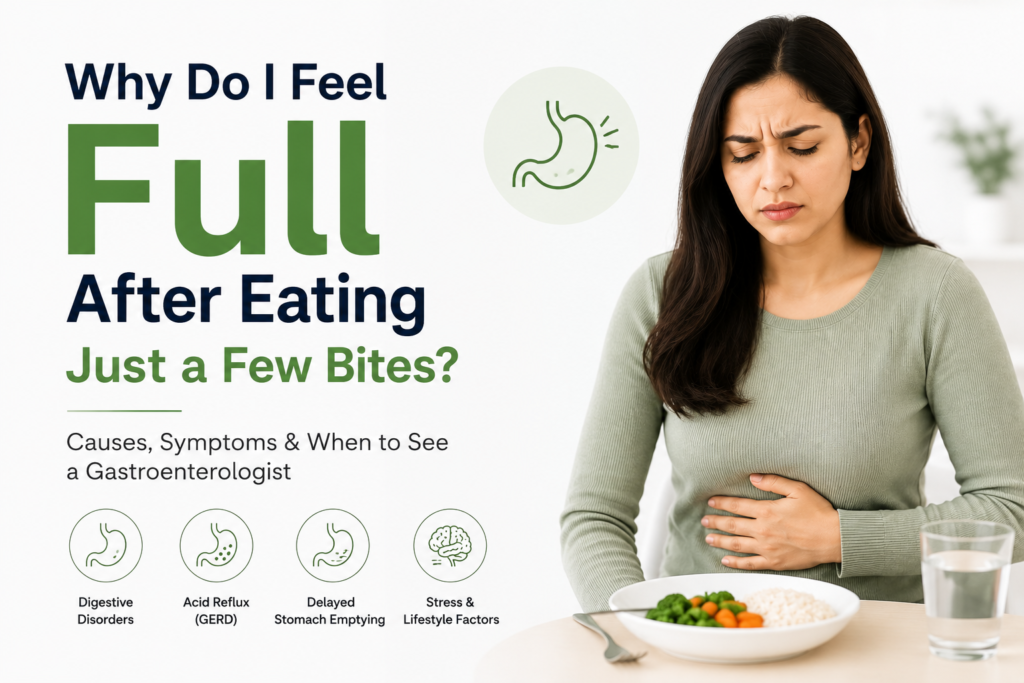
You sit down for a meal. After two or three bites, you feel completely full — even uncomfortably so. You have barely eaten anything. Yet your stomach feels as though it cannot take any more.
This experience is called early satiety — and when it happens consistently, it is your digestive system signalling something specific. Moreover, feeling full after just a few bites every day is not a normal digestive experience. It is a symptom that always deserves proper medical evaluation.
This guide explains exactly what causes early satiety, which digestive conditions produce it, what warning signs accompany it, and when to see a gastroenterologist.
Feeling full after eating just a few bites is called early satiety. It most commonly results from gastroparesis, functional dyspepsia, GERD, gastritis, or peptic ulcer disease. Less commonly, it can indicate liver disease, ascites, or gastrointestinal cancer. Early satiety that occurs daily for more than two weeks always warrants specialist evaluation. Patients experiencing persistent digestive symptoms can consult a gastroenterologist for proper evaluation and treatment.
What Is Early Satiety?
Early satiety is the medical term for feeling full much sooner than expected during a meal — after consuming far less food than normal. Moreover, it differs from simply having a small appetite. True early satiety produces a physical sensation of fullness — sometimes accompanied by nausea, bloating, or discomfort — after just a few bites of food.
Why Early Satiety Is More Than Just a Small Appetite
A small appetite means you do not feel particularly hungry before eating. Early satiety, however, means you feel genuinely full — often uncomfortably so — almost immediately after starting to eat. Furthermore, this distinction matters because each points to different underlying mechanisms and conditions.
Consequently, accurately describing your experience to a doctor — specifically that fullness occurs after eating, not before — helps them identify the correct cause more efficiently.
Symptoms Checklist — Does This Sound Like You?
Check the symptoms that apply to your experience:
☐ Feel full after eating just two or three bites of food
☐ Cannot finish a normal-sized meal even when hungry
☐ Stomach feels distended or bloated shortly after eating
☐ Nausea accompanies the fullness sensation
☐ Upper abdominal discomfort or heaviness after eating
☐ Weight loss without intentionally dieting
☐ Food feels like it is sitting in your stomach for hours
☐ Vomiting undigested food eaten hours earlier
☐ Loss of appetite alongside early fullness
☐ Symptoms worsen progressively over recent weeks
If you checked 3 or more: Your symptoms suggest an underlying digestive condition requiring specialist evaluation. Furthermore, early satiety combined with unexplained weight loss always requires urgent medical assessment — regardless of how many other symptoms you checked.
8 Causes of Feeling Full After Just a Few Bites
1. Gastroparesis — The Most Common Cause
Gastroparesis is a condition in which the stomach empties its contents into the small intestine more slowly than normal. Food sits in the stomach far longer than it should. Consequently, the stomach remains full from a previous meal — making a person feel full after just a few bites of the next meal.
Moreover, gastroparesis disrupts normal gastric motility — the coordinated muscle contractions that push food through the stomach. Furthermore, the vagus nerve controls these contractions. When the vagus nerve is damaged — most commonly by diabetes — gastroparesis develops progressively.
Who Develops Gastroparesis
People with diabetes are at significantly higher risk — because chronic high blood sugar damages the vagus nerve over time. Moreover, gastroparesis also occurs after gastric surgery, in people with thyroid disorders, and sometimes without any identifiable cause. Consequently, any diabetic patient experiencing early satiety alongside nausea should specifically mention gastroparesis when consulting their gastroenterologist.
2. Functional Dyspepsia
Functional dyspepsia is chronic indigestion without any visible structural abnormality. It causes early satiety, bloating, upper abdominal discomfort, and nausea — often triggered by eating even small amounts of food.
Moreover, functional dyspepsia involves abnormal gastric sensory function — the stomach sends fullness signals to the brain far sooner than normal food volume warrants. Furthermore, stress significantly worsens functional dyspepsia — making symptoms more pronounced during periods of anxiety or professional pressure.
Functional Dyspepsia and Early Satiety
Many patients with functional dyspepsia report feeling full after just a few bites as their primary complaint — even though their stomach is anatomically normal. Consequently, a gastroenterologist diagnoses functional dyspepsia after excluding structural causes through endoscopy and other investigations.
3. Gastritis and H. Pylori Infection
Gastritis — inflammation of the stomach lining — significantly reduces the stomach’s functional capacity. An inflamed stomach produces excess acid and signals fullness far sooner than a healthy one. Moreover, H. pylori bacterial infection is the most common cause of gastritis in India — affecting a large proportion of the adult population.
Furthermore, H. pylori-related gastritis produces early satiety, bloating, nausea, and upper abdominal discomfort — all symptoms that significantly improve once the infection is detected and eradicated with a targeted antibiotic course.
4. Peptic Ulcer Disease
A peptic ulcer is an open sore on the stomach lining or upper intestine. Ulcers reduce the stomach’s comfortable food capacity significantly. Moreover, the stomach’s response to incoming food near an ulcer is to signal fullness and discomfort rapidly — a protective mechanism that limits further irritation.
Furthermore, peptic ulcer-related early satiety is often accompanied by a distinctive gnawing or burning pain — particularly between meals or at night. Consequently, this pain pattern alongside early satiety strongly suggests peptic ulcer as the underlying cause.
5. GERD and Oesophageal Conditions
Severe GERD can reduce the stomach’s effective functional capacity. Moreover, chronic acid damage to the lower oesophagus can produce strictures — narrowings that make swallowing difficult and create a sensation of food “getting stuck” after just a few bites.
Furthermore, eosinophilic oesophagitis — an increasingly recognised inflammatory condition of the oesophagus — produces early satiety and food impaction after eating minimal amounts. Consequently, early satiety alongside difficulty swallowing always warrants an endoscopy to assess the oesophageal lining directly.
6. Liver Disease and Ascites
Advanced liver disease — including cirrhosis and severe fatty liver — can cause fluid accumulation in the abdominal cavity, called ascites. This fluid physically compresses the stomach — reducing its capacity dramatically. Consequently, patients with ascites feel full after just a few bites because the stomach physically cannot expand to its normal volume.
Moreover, ascites produces progressive abdominal distension that worsens over days and weeks. Furthermore, it is always associated with serious underlying liver or cardiac disease. Consequently, early satiety combined with progressive abdominal swelling requires urgent specialist evaluation without delay.
7. Gastrointestinal Cancer
Stomach cancer, pancreatic cancer, and certain other gastrointestinal cancers can produce early satiety — either by directly reducing stomach capacity or by creating systemic effects that suppress appetite and alter gastric motility.
Moreover, cancer-related early satiety is typically accompanied by other warning signs — unexplained weight loss, progressive loss of appetite, fatigue, and sometimes difficulty swallowing. Furthermore, early satiety combined with any of these red flag symptoms always requires urgent investigation — regardless of the patient’s age.
8. Anxiety and the Gut-Brain Axis
Chronic anxiety directly affects gastric motility and sensory function through the gut-brain axis. Moreover, anxious individuals frequently experience accelerated gastric fullness signals — feeling full after minimal food intake even without any structural stomach abnormality.
Furthermore, this mechanism explains why early satiety often worsens during periods of intense stress — examinations, work deadlines, or personal difficulties. Consequently, psychological factors always form part of the assessment when structural causes have been excluded through investigation.
Myth vs Fact — Early Satiety
| 🔴 Myth | 🟢 Fact |
|---|---|
| “Feeling full quickly just means I have a small stomach” | Early satiety is a medical symptom — it indicates abnormal gastric motility or sensory function |
| “Eating less will help my stomach shrink and fix the problem” | Restrictive eating worsens nutritional status without addressing the underlying cause |
| “Only elderly people get gastroparesis” | Gastroparesis affects people of all ages — particularly diabetics and those post-gastric surgery |
| “Early satiety is just stress — it will pass on its own” | Persistent early satiety always warrants evaluation — stress-related causes still require treatment |
| “If I can eat at all, it cannot be serious” | Gastrointestinal cancer and liver disease can both present with early satiety initially |
| “Antacids will fix early satiety” | Antacids address acid — not motility disorders, ulcers, or structural causes of early satiety |
People Also Ask
Why do I feel full after eating just a few bites?
Feeling full after just a few bites — called early satiety — most commonly results from gastroparesis, functional dyspepsia, gastritis, peptic ulcer, or GERD. Less commonly, it indicates liver disease with ascites or gastrointestinal cancer. Persistent early satiety for more than two weeks always warrants gastroenterologist evaluation.
Is early satiety a sign of cancer?
Early satiety can occasionally indicate gastrointestinal cancer — particularly stomach or pancreatic cancer. However, the vast majority of early satiety cases result from manageable conditions like gastroparesis or functional dyspepsia. Furthermore, cancer-related early satiety is typically accompanied by significant weight loss, progressive appetite loss, and fatigue — which prompts urgent investigation.
Can anxiety cause early satiety?
Yes — anxiety disrupts normal gastric motility and sensory function through the gut-brain axis. Moreover, anxious individuals experience gastric fullness signals earlier than normal — producing early satiety without any structural stomach abnormality. Treating anxiety alongside any identified digestive condition consistently produces better outcomes than treating either alone.
What tests diagnose the cause of early satiety?
An upper GI endoscopy directly examines the stomach and oesophageal lining. A gastric emptying study assesses how quickly food leaves the stomach — diagnosing gastroparesis. Blood tests including H. pylori testing, liver function tests, and tumour markers provide additional diagnostic information. An abdominal ultrasound rules out ascites and liver disease.
How is gastroparesis treated?
Gastroparesis treatment focuses on dietary modification — smaller, more frequent meals with less fat and fibre. Medications that improve gastric motility are prescribed in moderate to severe cases. Moreover, treating the underlying cause — particularly diabetes control — often improves gastroparesis significantly over time. A gastroenterologist tailors treatment to each patient’s specific severity and underlying condition.
When Should You See a Gastroenterologist?
Early satiety that occurs occasionally — particularly during illness or stress — is not usually concerning. However, see a gastroenterologist promptly if:
- You feel full after just a few bites at every meal for more than two weeks
- Early satiety is accompanied by nausea or vomiting
- You are losing weight without trying
- Your appetite has declined progressively over recent weeks
- Early satiety accompanies difficulty swallowing
- You vomit food eaten several hours earlier
- Abdominal distension accompanies your fullness
- You experience fatigue alongside your digestive symptoms
Furthermore, patients experiencing persistent digestive symptoms can consult a gastroenterologist for proper evaluation and treatment — because most conditions causing early satiety respond well to treatment when identified early.
FAQs
What does it mean when you feel full after eating just a few bites?
Feeling full after just a few bites is called early satiety. It indicates abnormal gastric motility, altered stomach sensory function, or reduced gastric capacity from an underlying condition. Common causes include gastroparesis, functional dyspepsia, gastritis, peptic ulcer, GERD, liver disease with ascites, and anxiety-related gut-brain axis disruption.
How long does early satiety last?
Duration depends on the underlying cause. Acute gastritis-related early satiety often resolves within days of treatment. Gastroparesis and functional dyspepsia require longer management. Furthermore, early satiety persisting beyond two weeks without improvement always warrants specialist evaluation to identify and address the specific underlying cause.
Can I gain weight if I feel full after a few bites?
Very difficult — early satiety significantly limits caloric intake over time. Moreover, progressive weight loss accompanying early satiety is a red flag requiring urgent evaluation. Consequently, nutritional support is often part of treatment for severe early satiety — particularly in gastroparesis and advanced digestive conditions.
What should I eat if I feel full after a few bites?
Small, frequent meals — six per day rather than three large ones — help manage early satiety. Low-fat, low-fibre foods empty from the stomach more easily. Liquids and semi-solid foods are often better tolerated than solid meals. However, dietary management alone does not treat the underlying condition — always combine it with proper medical evaluation.
Which specialist treats early satiety in Varanasi?
A gastroenterologist is the right specialist for persistent early satiety. Dr. Shekhar Puri at Samarpan Gastro and Liver Clinic, Varanasi, diagnoses and treats gastroparesis, functional dyspepsia, peptic ulcer, gastritis, GERD, and liver conditions — all of which can cause early satiety.
Consult Dr. Shekhar Puri — Varanasi’s Trusted Gastroenterologist
Feeling full after just a few bites at every meal is not something you should accept as normal. It is a consistent signal from your digestive system — and it deserves a thorough evaluation rather than indefinite dietary restriction.
Most conditions causing early satiety are highly treatable when identified correctly. Moreover, early evaluation prevents nutritional deficiency, progressive weight loss, and the worsening of underlying conditions that proper treatment would have addressed far more effectively.
Dr. Shekhar Puri at Samarpan Gastro and Liver Clinic, Varanasi specialises in diagnosing and treating gastroparesis, peptic ulcer, gastritis, fatty liver, GERD, and the complete range of digestive and liver conditions causing early satiety. With advanced endoscopy and comprehensive diagnostic services under one roof, Dr. Puri provides clear answers and effective, personalised treatment.
Patients experiencing persistent digestive symptoms can consult a gastroenterologist for proper evaluation and treatment — and the earlier you seek this, the simpler and more effective the solution will be.
Book your appointment today via WhatsApp — because feeling full after a few bites every day deserves a real answer, not an indefinite diet plan.
According to the Indian Society of Gastroenterology, early satiety is one of the most commonly underreported digestive symptoms in India — with many patients attributing it to stress or age rather than seeking appropriate specialist evaluation.
⚠️ Medical Disclaimer: This blog is for general informational purposes only and does not constitute medical advice. Always consult a qualified doctor for diagnosis and personalised treatment.
