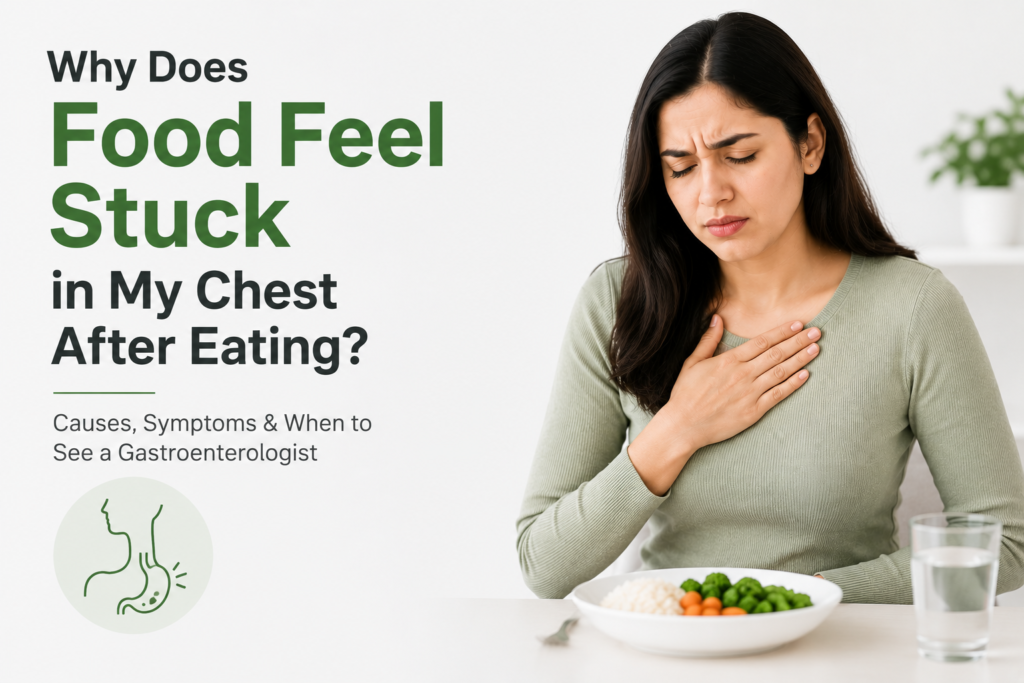
You take a bite of food. It travels down — but then seems to stop midway. You feel a sensation of something stuck in your chest or throat. Sometimes it passes after a few seconds. Sometimes it is persistent and uncomfortable.
This experience is called dysphagia — and when food feels stuck in your chest after eating consistently, it is a symptom that always deserves proper medical evaluation. Moreover, many people dismiss it as eating too quickly or swallowing incorrectly. However, frequent dysphagia almost always has a specific underlying cause that a gastroenterologist can identify and treat.
This guide explains exactly why food feels stuck in your chest, which conditions cause it, what warning signs accompany it, and when to seek specialist help.
When food feels stuck in your chest after eating, this is called dysphagia or oesophageal dysphagia. It most commonly results from GERD causing oesophageal stricture, eosinophilic oesophagitis, achalasia, peptic ulcer, or oesophageal cancer. Any food sticking sensation occurring more than twice per week always warrants gastroenterologist evaluation — especially when accompanied by weight loss, pain, or regurgitation. Patients experiencing persistent digestive symptoms can consult a gastroenterologist for proper evaluation and treatment.
What Is Dysphagia?
Dysphagia means difficulty swallowing. It occurs when food or liquid does not pass smoothly from the mouth through the oesophagus into the stomach.
Oropharyngeal dysphagia affects the throat — producing difficulty initiating swallowing. Moreover, this type is more common in neurological conditions like stroke or Parkinson’s disease.
Oesophageal dysphagia — which is what most people describe as food feeling stuck in the chest — occurs when food passes the throat normally but then encounters an obstruction or motility problem in the oesophagus.
Furthermore, the distinction between these two types helps your gastroenterologist identify the most likely cause and select the appropriate investigation.
Symptoms Checklist — Does This Sound Like You?
Check the symptoms that apply to your experience:
☐ Food feels stuck in chest or throat during or after swallowing
☐ Need to drink water immediately to help food go down
☐ Sensation worse with solid foods than liquids
☐ Sensation worse with liquids and solids equally
☐ Food or liquid comes back up shortly after swallowing
☐ Chest pain or burning alongside the sticking sensation
☐ Coughing or choking while eating
☐ Weight loss from avoiding difficult foods
☐ Symptoms worsening progressively over weeks or months
☐ Heartburn or acid reflux accompanying the sticking sensation
If you checked 3 or more: Your symptoms suggest an underlying oesophageal or digestive condition requiring gastroenterologist evaluation. Furthermore, progressive dysphagia — worsening over weeks — always requires urgent investigation.
8 Causes of Food Feeling Stuck in the Chest
1. GERD and Oesophageal Stricture
Chronic acid reflux is one of the most common causes of food feeling stuck in the chest. When acid repeatedly contacts the oesophageal lining, it causes inflammation and scarring. Moreover, this scarring progressively narrows the oesophageal channel — a condition called oesophageal stricture.
Patients with strictures typically describe solid food — bread, rice, meat — getting stuck at the same point in the chest every time they eat. Furthermore, the sensation often improves temporarily after drinking water or waiting a few moments. Consequently, many patients modify their diet around the stricture for months before seeking help — by which time significant narrowing has often developed.
How Stricture Develops From Untreated Reflux
Chronic GERD damages the lower oesophageal lining progressively. Moreover, the repair process deposits collagen — producing fibrous scar tissue that is stiffer and narrower than normal oesophageal tissue. Furthermore, each acid exposure episode adds another layer of damage. Consequently, a stricture that begins as mild narrowing can progress to severe obstruction requiring endoscopic dilation.
2. Eosinophilic Oesophagitis (EoE)
Eosinophilic oesophagitis is an increasingly recognised inflammatory condition of the oesophagus — driven by an immune response to food allergens. It causes the oesophageal lining to become swollen, rigid, and unable to expand normally during swallowing.
Moreover, EoE is particularly common in younger patients — including children, adolescents, and adults in their 20s and 30s. Furthermore, the classic presentation is food impaction — food becoming completely stuck and requiring emergency endoscopy for removal. Consequently, any episode of complete food impaction always warrants investigation for EoE.
EoE Diagnosis and Treatment
Endoscopy with biopsy is required for EoE diagnosis. Moreover, the oesophageal lining shows characteristic rings, furrows, and whitish exudates on visual examination. Furthermore, dietary elimination of trigger foods — particularly dairy, wheat, eggs, nuts, soy, and seafood — produces significant improvement in most patients. Consequently, early diagnosis dramatically reduces the risk of food impaction episodes.
3. Achalasia — Failed Oesophageal Relaxation
Achalasia is a rare but important oesophageal motility disorder. In achalasia, the lower oesophageal sphincter — the valve between the oesophagus and stomach — fails to relax normally during swallowing.
Moreover, food accumulates in the oesophagus above this tight sphincter — producing a progressive sensation of food stuck in the chest with every meal. Furthermore, achalasia affects both solids and liquids equally — unlike strictures, which typically affect solids more than liquids. Consequently, dysphagia to both solids and liquids from the beginning of symptoms strongly suggests achalasia.
Achalasia Treatment
Achalasia requires specific treatment — either pneumatic balloon dilation or surgical myotomy to disrupt the tight sphincter. Moreover, an ERCP or oesophageal manometry test confirms the diagnosis before treatment planning. Furthermore, effective treatment produces dramatic improvement in swallowing and quality of life in most patients.
4. Peptic Ulcer Affecting the Oesophagus
A peptic ulcer in the lower oesophagus — called an oesophageal ulcer — can produce a sensation of food sticking at the level of the ulcer. Moreover, the ulcerated tissue is inflamed, swollen, and tender — reducing the functional diameter of the oesophagus temporarily.
Furthermore, oesophageal ulcers typically produce chest pain alongside the sticking sensation — particularly a burning pain worsened by swallowing acidic foods or liquids. Consequently, oesophageal ulcers are identified on upper GI endoscopy and treated effectively with a course of acid-suppressing medication.
5. Oesophageal Cancer
Oesophageal cancer is one of the most serious causes of food feeling stuck in the chest — and one that always requires exclusion in any adult presenting with progressive dysphagia.
Moreover, the characteristic presentation of oesophageal cancer is progressive dysphagia — difficulty initially with solid foods, then with soft foods, and eventually with liquids — alongside significant, unexplained weight loss. Furthermore, oesophageal cancer typically affects adults above 50 — particularly those with long-standing GERD, smoking history, or excessive alcohol consumption.
Consequently, progressive dysphagia combined with weight loss always requires urgent endoscopy without delay — because early-stage oesophageal cancer is significantly more treatable than advanced disease.
6. Oesophageal Spasm
Oesophageal spasm is a motility disorder in which the oesophageal muscles contract in a disorganised, painful manner rather than the smooth, coordinated waves required for normal swallowing.
Moreover, spasm produces a distinctive sensation — food stuck in the chest alongside significant chest pain that can mimic cardiac pain closely. Furthermore, the pain may radiate to the back, jaw, or arm — making it essential to rule out cardiac causes before attributing chest pain to oesophageal spasm.
Consequently, any new chest pain during swallowing that has not been previously investigated requires medical evaluation — to confirm oesophageal rather than cardiac origin before proceeding to specific digestive treatment.
7. Globus Sensation
Globus is a persistent sensation of a lump or obstruction in the throat — occurring between meals rather than during swallowing. Moreover, it does not actually interfere with swallowing when patients try to eat or drink.
Furthermore, globus is frequently associated with anxiety, GERD, and post-nasal drip rather than structural oesophageal disease. Consequently, a key distinguishing feature is that globus typically improves during actual swallowing — whereas true dysphagia worsens specifically during the act of swallowing.
8. External Compression of the Oesophagus
Enlarged lymph nodes, thyroid goitre, aortic aneurysm, or mediastinal masses can press on the oesophagus from outside — producing a sensation of narrowing and food sticking. Moreover, external compression produces progressive dysphagia without any oesophageal mucosal abnormality on endoscopy.
Furthermore, this distinction — normal oesophageal lining despite clear dysphagia — prompts CT scan or MRI to identify the compressing structure. Consequently, an endoscopy that shows normal mucosa in a patient with significant dysphagia always requires further cross-sectional imaging before excluding a structural cause.
Myth vs Fact — Food Stuck in Chest
| 🔴 Myth | 🟢 Fact |
|---|---|
| “Food sticking is just from eating too fast” | Frequent sticking regardless of eating speed indicates an oesophageal condition requiring investigation |
| “Drinking water fixes the problem” | Water may temporarily relieve the sensation — it does not treat the underlying cause |
| “Only elderly people get oesophageal problems” | Eosinophilic oesophagitis and achalasia commonly affect young adults in their 20s and 30s |
| “Chest pain from food sticking is always GERD” | Oesophageal spasm can closely mimic cardiac chest pain — always investigate new chest pain properly |
| “If I can still swallow liquids, nothing is seriously wrong” | Early oesophageal cancer presents with solid food dysphagia before liquids are affected |
| “Endoscopy is only needed if food completely gets stuck” | Any progressive or frequent dysphagia warrants endoscopy — not only complete obstruction |
People Also Ask
Why does food feel stuck in my chest after eating?
Food feeling stuck in the chest after eating — called oesophageal dysphagia — most commonly results from GERD causing oesophageal stricture, eosinophilic oesophagitis, achalasia, oesophageal ulcer, or oesophageal spasm. Less commonly, it indicates oesophageal cancer or external oesophageal compression. Any frequent or progressive sticking sensation always warrants gastroenterologist evaluation.
Is food sticking in the chest a sign of cancer?
Progressive dysphagia — food sticking that worsens over weeks from solids to liquids — combined with unexplained weight loss is a combination that always requires urgent investigation for oesophageal cancer. However, most cases of food sticking result from treatable conditions like GERD stricture, EoE, or achalasia. Endoscopy distinguishes these reliably.
What is the difference between globus and dysphagia?
Globus is a persistent throat lump sensation present between meals — that improves or disappears during actual swallowing. Dysphagia is difficulty specifically during swallowing — food feeling stuck in the chest while eating. Furthermore, globus is usually benign and anxiety-related, while dysphagia requires thorough oesophageal investigation.
Can anxiety cause food to feel stuck in the chest?
Yes — anxiety can produce oesophageal spasm and worsen globus sensation. Moreover, stress significantly worsens GERD — which can contribute to oesophageal irritation and swallowing discomfort. However, anxiety alone does not explain progressive dysphagia or food impaction — which always require structural investigation.
What test diagnoses why food feels stuck in the chest?
An upper GI endoscopy is the primary diagnostic tool — directly examining the oesophageal lining for stricture, EoE, ulcers, and tumours. Oesophageal manometry assesses motility disorders like achalasia and spasm. Moreover, a barium swallow study provides a dynamic assessment of oesophageal function during swallowing.
When Should You See a Gastroenterologist?
Many patients endure food sticking for months — modifying their diet to avoid difficult foods rather than seeking help. However, see a gastroenterologist promptly if:
- Food feels stuck in your chest more than twice per week
- The sticking sensation is getting progressively worse
- You are losing weight because of difficulty eating
- Food or liquid comes back up immediately after swallowing
- Chest pain accompanies the sticking sensation
- You have had a complete food impaction — food completely stuck requiring hospital treatment
- You have been taking antacids for more than four weeks without improvement
Furthermore, patients experiencing persistent digestive symptoms can consult a gastroenterologist for proper evaluation and treatment — because early identification of the cause produces significantly better outcomes than delayed investigation.
FAQs
What does it mean when food feels stuck in your chest?
Food feeling stuck in the chest indicates oesophageal dysphagia — a difficulty with food passing through the oesophagus into the stomach. Common causes include GERD-related stricture, eosinophilic oesophagitis, achalasia, oesophageal ulcer, and oesophageal spasm. Less commonly, it indicates oesophageal cancer or external compression. Endoscopy identifies the specific cause reliably.
How is food sticking in the chest treated?
Treatment depends entirely on the underlying cause. Oesophageal strictures are dilated endoscopically. EoE responds to dietary elimination and topical steroids. Achalasia requires pneumatic dilation or surgery. Peptic ulcers respond to acid-suppressing medication. Oesophageal cancer requires specialist oncology management. Consequently, identifying the specific cause through endoscopy is essential before any treatment begins.
Can GERD cause food to stick in the chest?
Yes — chronic untreated GERD causes oesophageal scarring and stricture formation. The resulting narrowing makes solid food feel stuck at the same point in the chest every time. Moreover, treating the underlying GERD alongside endoscopic stricture dilation prevents recurrence. Consequently, patients with long-standing GERD who develop dysphagia should seek gastroenterologist evaluation promptly.
Is food sticking in the chest an emergency?
Complete food impaction — food completely stuck with inability to swallow even saliva — is a gastroenterological emergency requiring same-day endoscopy for removal. However, intermittent food sticking without complete obstruction is not an emergency — but does require prompt scheduled evaluation rather than indefinite self-management.
Which specialist treats food sticking in the chest in Varanasi?
A gastroenterologist is the right specialist for oesophageal dysphagia. Dr. Shekhar Puri at Samarpan Gastro and Liver Clinic, Varanasi, diagnoses and treats oesophageal stricture, eosinophilic oesophagitis, achalasia, peptic ulcer, and oesophageal motility disorders — with advanced endoscopy and comprehensive oesophageal assessment available under one roof.
Consult Dr. Shekhar Puri — Varanasi’s Trusted Gastroenterologist
When food feels stuck in your chest repeatedly — this is not something to manage with dietary restriction alone. It is your oesophagus signalling a specific, identifiable, and treatable problem.
Early evaluation identifies the exact cause — and most causes respond very well to treatment when caught before significant progression. Moreover, conditions like achalasia and oesophageal stricture that go untreated for years become progressively harder to manage — making early investigation genuinely important.
Dr. Shekhar Puri at Samarpan Gastro and Liver Clinic, Varanasi specialises in diagnosing and treating the complete range of oesophageal and digestive conditions — from GERD stricture, peptic ulcer, and eosinophilic oesophagitis to achalasia, oesophageal spasm, and digestive disorders. With advanced endoscopy and comprehensive oesophageal assessment under one roof, Dr. Puri provides clear answers and effective, personalised treatment.
Patients experiencing persistent digestive symptoms can consult a gastroenterologist for proper evaluation and treatment — and the earlier you seek this, the simpler and more effective your treatment will be.
Book your appointment today via WhatsApp — because food feeling stuck in your chest every time you eat deserves a real answer, not an indefinite soft-food diet.
According to the Indian Society of Gastroenterology, oesophageal dysphagia is one of the most commonly underinvestigated digestive symptoms in India — with many patients modifying their diet around the problem for months before appropriate specialist evaluation is sought.
⚠️ Medical Disclaimer: This blog is for general informational purposes only and does not constitute medical advice. Always consult a qualified doctor for diagnosis and personalised treatment.
