You finish a meal. Minutes later, you notice food coming back into your mouth — partially digested, tasting sour or bitter, without any warning or nausea. It is uncomfortable, embarrassing, and confusing.
Most people assume this is simply burping. However, food returning to the mouth after eating is a distinct symptom called regurgitation — and it is different from vomiting, different from burping, and different from simple acidity. Moreover, when it happens regularly, it almost always indicates a specific digestive condition that needs proper evaluation.
This guide explains exactly why food comes back into your mouth after eating, whether it is acid reflux or GERD, and when to see a gastroenterologist.
Food coming back into the mouth after eating is called regurgitation. It most commonly indicates GERD — where a weakened lower oesophageal sphincter allows stomach contents to travel upward effortlessly. However, it can also indicate achalasia, rumination syndrome, oesophageal stricture, or gastroparesis. Regurgitation occurring more than twice per week always warrants gastroenterologist evaluation. Patients experiencing persistent digestive symptoms can consult a gastroenterologist for proper evaluation and treatment.
What Is Regurgitation? Is It the Same as Vomiting?
Regurgitation and vomiting are completely different experiences — though patients sometimes confuse them.
Regurgitation is the passive, effortless return of food or acid from the oesophagus or stomach into the mouth. Moreover, it occurs without nausea, without abdominal contractions, and without warning. Furthermore, the returned material tastes sour or bitter — reflecting the acid or bile mixed with it.
Vomiting is an active, forceful expulsion driven by strong abdominal and diaphragmatic muscle contractions. Moreover, it is almost always preceded by nausea and produces a significant physical effort.
Consequently, if food returns to your mouth effortlessly — without nausea or effort — this is regurgitation rather than vomiting. Furthermore, this distinction is clinically important — because regurgitation and vomiting have different causes, different investigations, and different treatments.
Symptoms Checklist — Does This Sound Like You?
Check the symptoms that apply to your experience:
☐ Food or liquid returns to mouth after eating without effort or nausea
☐ Sour or bitter taste accompanies the returned food
☐ Sensation of liquid rising into the throat after meals
☐ Regurgitation worsens when bending forward or lying down
☐ Food returns to mouth during sleep — waking you up
☐ Heartburn or chest burning alongside regurgitation
☐ Chronic cough — particularly after meals or at night
☐ Hoarse voice or sore throat in the morning
☐ Regurgitation occurring regardless of meal size
☐ Difficulty swallowing alongside regurgitation episodes
If you checked 3 or more: Your symptoms suggest an underlying digestive condition requiring gastroenterologist evaluation. Furthermore, regurgitation combined with difficulty swallowing or weight loss always requires urgent specialist assessment.
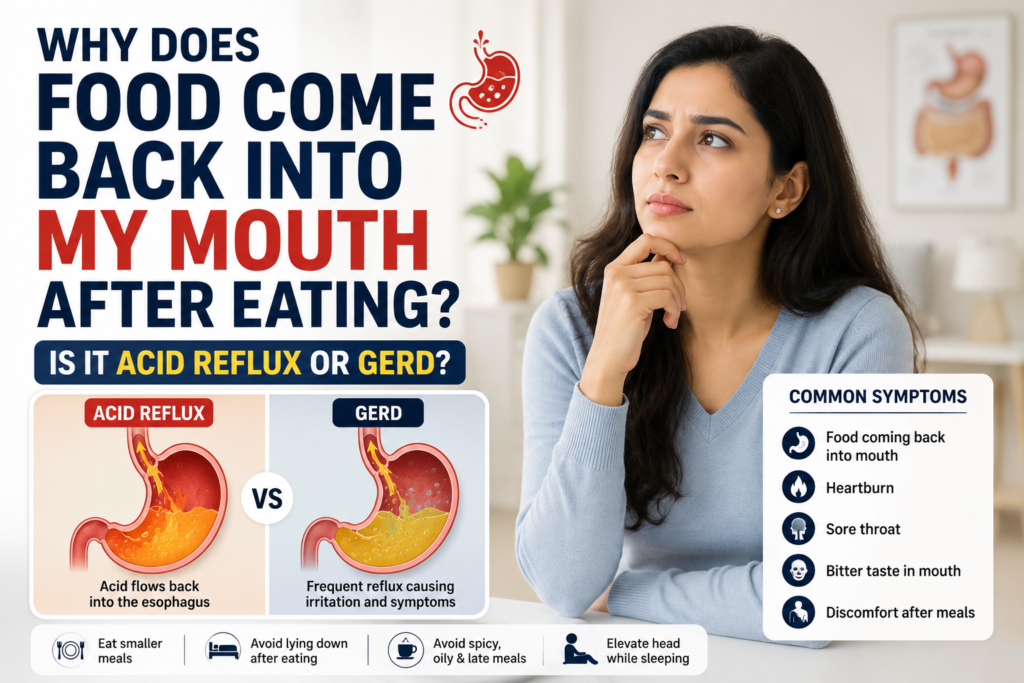
Is It Acid Reflux or GERD? Understanding the Difference
Many patients use “acid reflux” and “GERD” interchangeably — but they are not the same thing.
Acid reflux is the event — stomach acid escaping upward into the oesophagus. Moreover, virtually everyone experiences acid reflux occasionally — after a large meal, lying down after eating, or consuming alcohol or spicy food.
GERD — Gastroesophageal Reflux Disease — is the chronic condition. It is diagnosed when acid reflux occurs more than twice per week consistently — causing symptoms that affect quality of life or produce measurable oesophageal damage.
Furthermore, regurgitation is one of the two cardinal symptoms of GERD — alongside heartburn. Consequently, food coming back into the mouth regularly is not simply “a bit of acid reflux” — it is a defining feature of GERD that warrants proper diagnosis and treatment.
7 Causes of Food Coming Back Into the Mouth
1. GERD — The Most Common Cause
GERD is responsible for the majority of regurgitation episodes in Indian adults. In GERD, the lower oesophageal sphincter — the muscular valve separating the stomach from the oesophagus — weakens or relaxes inappropriately.
Moreover, when this valve is weak, stomach contents travel upward passively — particularly when lying down, bending forward, or when intragastric pressure increases after meals. Furthermore, GERD-related regurgitation typically brings a mixture of partially digested food and stomach acid — producing the characteristic sour taste.
What Makes GERD Regurgitation Worse
Several factors directly worsen GERD regurgitation. Eating large meals distends the stomach — increasing upward pressure on the weakened sphincter. Moreover, lying down within two to three hours of eating removes gravity’s protective role. Furthermore, alcohol, smoking, fatty foods, coffee, and chocolate all relax the lower oesophageal sphincter directly — making regurgitation more frequent and more severe.
2. Achalasia — A Motility Disorder
Achalasia is a condition in which the lower oesophageal sphincter fails to relax normally during swallowing — and oesophageal peristalsis is absent or disordered. Consequently, food accumulates in the oesophagus above the tight sphincter — and returns to the mouth without ever reaching the stomach.
Moreover, achalasia-related regurgitation has a distinctive characteristic — the returned material contains undigested food without any sour or acidic taste. Furthermore, patients with achalasia typically report equal difficulty with both solids and liquids — unlike GERD, which initially affects solids more than liquids.
Consequently, regurgitation of undigested, non-acidic food should always prompt investigation for achalasia — because the treatment differs completely from GERD management.
3. Rumination Syndrome
Rumination syndrome is a behavioural condition — often unrecognised — in which recently swallowed food is voluntarily or involuntarily returned to the mouth, chewed again, and re-swallowed or spat out. Moreover, this occurs within minutes of eating — not hours later.
Furthermore, rumination is more common than most doctors and patients realise — particularly in adolescents and young adults. The returned food is typically undigested and non-acidic — distinguishing it from GERD regurgitation.
Consequently, rumination syndrome requires a different therapeutic approach — primarily behavioural therapy and diaphragmatic breathing training — rather than acid-suppressing medication.
4. Oesophageal Stricture
A narrowing of the oesophageal channel — caused by chronic acid damage, eosinophilic oesophagitis, or previous injury — prevents food from passing into the stomach normally. Moreover, food accumulates above the stricture — and returns to the mouth when the oesophagus cannot accommodate more.
Furthermore, stricture-related regurgitation is typically associated with progressive difficulty swallowing — starting with solid foods and eventually affecting soft foods and liquids. Consequently, regurgitation alongside worsening dysphagia always requires urgent endoscopy to assess for oesophageal stricture or other structural obstruction.
5. Gastroparesis
Gastroparesis — delayed gastric emptying — causes food to accumulate in the stomach far beyond the normal digestion period. When the stomach becomes overly distended with retained food, contents can travel upward — particularly when lying down or bending forward.
Moreover, gastroparesis-related regurgitation involves food eaten hours earlier — not immediately after meals. Furthermore, it is typically accompanied by bloating, early satiety, and nausea. Consequently, regurgitation of food eaten several hours previously — rather than within 30 to 60 minutes of eating — should prompt investigation for gastroparesis.
6. Hiatus Hernia
A hiatus hernia — where part of the stomach pushes upward through the diaphragm — permanently impairs the lower oesophageal sphincter’s ability to maintain the barrier between stomach and oesophagus.
Moreover, the herniated stomach segment acts as a reservoir — trapping acid and food close to the oesophageal opening. Furthermore, this anatomical change makes regurgitation significantly more frequent and more severe than in GERD without a hernia.
Consequently, patients with severe or treatment-resistant regurgitation should specifically request assessment for hiatus hernia — which an endoscopy or barium swallow study identifies reliably.
7. Laryngopharyngeal Reflux (LPR)
Laryngopharyngeal reflux — sometimes called silent reflux — occurs when acid travels all the way from the stomach to the throat and voice box without producing typical heartburn. Moreover, LPR patients often report a sensation of liquid rising into the throat, chronic throat-clearing, hoarseness, and a persistent sensation of mucus in the throat.
Furthermore, LPR frequently occurs without any heartburn whatsoever — making patients — and sometimes doctors — dismiss the digestive origin of their symptoms. Consequently, chronic throat symptoms alongside occasional food regurgitation — even without heartburn — should prompt LPR assessment.
Myth vs Fact — Food Coming Back Into the Mouth
| 🔴 Myth | 🟢 Fact |
|---|---|
| “Food coming back up is just burping” | Regurgitation is the passive return of food or acid — completely different from burping |
| “If I don’t have heartburn, it can’t be GERD” | Many GERD patients experience regurgitation without significant heartburn — called silent reflux |
| “Drinking water immediately after eating prevents it” | Water temporarily dilutes stomach acid — it does not prevent regurgitation from a weakened sphincter |
| “It happens because I eat too fast” | Eating speed affects aerophagia — not the sphincter weakness causing true regurgitation |
| “Antacids will fix regurgitation completely” | Antacids reduce acid but do not strengthen the lower oesophageal sphincter — regurgitation often persists |
| “Only elderly people get GERD-related regurgitation” | GERD and its regurgitation increasingly affect Indians in their 20s and 30s |
People Also Ask
Why does food come back into my mouth after eating?
Food returning to the mouth after eating — called regurgitation — most commonly indicates GERD, where a weakened lower oesophageal sphincter allows stomach contents to travel upward passively. Other causes include achalasia, rumination syndrome, oesophageal stricture, gastroparesis, and hiatus hernia. Regular regurgitation always warrants gastroenterologist evaluation.
Is regurgitation the same as acid reflux?
No — acid reflux is the upward movement of stomach acid into the oesophagus. Regurgitation is the return of food or liquid all the way to the mouth. Moreover, regurgitation is more severe than simple acid reflux — indicating that the reflux has reached a higher level. Furthermore, regurgitation is a defining symptom of GERD when it occurs regularly.
Can GERD cause food to come back into the mouth?
Yes — regurgitation is one of the two cardinal symptoms of GERD, alongside heartburn. When the lower oesophageal sphincter weakens significantly, stomach contents travel all the way to the mouth — particularly when lying down or bending forward. Moreover, nighttime regurgitation — food returning during sleep — strongly indicates GERD requiring prompt evaluation.
What is the difference between regurgitation and vomiting?
Regurgitation is effortless and passive — food returns without nausea or abdominal effort. Vomiting is forceful and active — driven by strong abdominal muscle contractions preceded by nausea. Furthermore, regurgitated material tastes sour or bitter from acid exposure, while vomited material reflects the contents of a nauseated, contracting stomach.
What tests diagnose why food comes back into the mouth?
An upper GI endoscopy directly examines the oesophagus for GERD damage, stricture, hiatus hernia, and achalasia. Oesophageal manometry measures sphincter pressure and peristalsis — diagnosing achalasia and dysmotility. A 24-hour pH monitoring study confirms the severity and pattern of acid reflux. Furthermore, a barium swallow provides a dynamic view of oesophageal function during swallowing.
When Should You See a Gastroenterologist?
Many patients manage regurgitation with antacids for months without investigating the underlying cause. However, see a gastroenterologist promptly if food comes back into your mouth:
- More than twice per week consistently
- During sleep — waking you from your rest
- Alongside difficulty swallowing solid or liquid foods
- With unexplained weight loss or appetite decline
- Despite taking prescribed proton pump inhibitors for four weeks
- Accompanied by chest pain — to exclude cardiac causes first
- With progressive worsening over recent weeks or months
- In a pattern suggesting undigested food — without acid taste
Furthermore, patients experiencing persistent digestive symptoms can consult a gastroenterologist for proper evaluation and treatment — because most causes of regular regurgitation respond well to treatment when identified correctly.
FAQs
What does it mean when food comes back into your mouth after eating?
Food returning to the mouth after eating — called regurgitation — indicates that stomach or oesophageal contents are travelling upward passively into the mouth. The most common cause is GERD from a weakened lower oesophageal sphincter. Other causes include achalasia, oesophageal stricture, hiatus hernia, gastroparesis, and rumination syndrome — each requiring different treatment.
How do I stop food from coming back into my mouth?
For immediate relief — avoid eating large meals, stay upright for three hours after eating, elevate the head of your bed, and avoid alcohol and fatty meals. However, these measures manage symptoms — they do not treat the underlying condition. A gastroenterologist identifies the specific cause and provides targeted treatment that addresses the root mechanism.
Can anxiety cause food to come back into the mouth?
Yes — anxiety worsens GERD by increasing stomach acid production and altering oesophageal motility through the gut-brain axis. Moreover, rumination syndrome — which produces regurgitation — has a strong psychological component. Consequently, anxiety management alongside medical treatment consistently produces better outcomes than medical treatment alone.
Is regurgitation during sleep serious?
Yes — nocturnal regurgitation is clinically significant. Food or acid reaching the throat during sleep can be aspirated into the airways — causing chronic cough, recurrent chest infections, or aspiration pneumonia. Moreover, prolonged nocturnal acid contact damages the oesophageal lining more severely than daytime reflux. Consequently, nighttime regurgitation always warrants prompt gastroenterologist evaluation.
Which specialist treats regurgitation in Varanasi?
A gastroenterologist is the right specialist for persistent regurgitation. Dr. Shekhar Puri at Samarpan Gastro and Liver Clinic, Varanasi, specialises in diagnosing and treating GERD, achalasia, oesophageal stricture, hiatus hernia, gastroparesis, and the complete range of oesophageal and digestive conditions causing food to return to the mouth.
Consult Dr. Shekhar Puri — Varanasi’s Trusted Gastroenterologist
Food coming back into your mouth after eating is not something to dismiss as a minor inconvenience. It is a consistent signal that your oesophageal barrier is not functioning as it should — and the sooner that is identified and treated, the simpler and more effective the solution will be.
Most causes of regular regurgitation are highly treatable. Moreover, early treatment prevents oesophageal damage from progressing to strictures, Barrett’s Oesophagus, or more complex conditions requiring intensive intervention.
Dr. Shekhar Puri at Samarpan Gastro and Liver Clinic, Varanasi specialises in diagnosing and treating GERD, peptic ulcer, stomach infection, and the complete range of digestive disorders causing regurgitation. With advanced endoscopy and comprehensive oesophageal assessment under one roof, Dr. Puri provides clear answers and effective, personalised treatment.
Patients experiencing persistent digestive symptoms can consult a gastroenterologist for proper evaluation and treatment — and the earlier you seek this, the better your outcomes will be.
Book your appointment today via WhatsApp — because food returning to your mouth after every meal deserves a real answer, not another antacid.
According to the Indian Society of Gastroenterology, GERD — including its cardinal symptom of regurgitation — is among the most prevalent and most undertreated digestive conditions in India, with significant long-term oesophageal complications arising from delayed specialist evaluation.
⚠️ Medical Disclaimer: This blog is for general informational purposes only and does not constitute medical advice. Always consult a qualified doctor for diagnosis and personalised treatment.
