Most people treat acidity the same way every time — reach for an antacid, get temporary relief, and carry on. For occasional heartburn, this approach is perfectly reasonable. However, when acidity is becoming serious, that same antacid habit quietly masks warning signs that deserve urgent medical attention.
The problem is that serious acidity-related conditions rarely announce themselves dramatically. Instead, they develop gradually — producing signals that are easy to dismiss as ordinary indigestion until the underlying condition has progressed significantly further than it needed to.
This guide identifies the seven warning signs that separate manageable everyday acidity from something that genuinely requires a gastroenterologist’s evaluation — and explains exactly what each sign means for your digestive health.
Why Acidity Becomes Serious — The Progression Most People Miss
Occasional acid reflux is a normal human experience. However, when acid repeatedly escapes the stomach and contacts the oesophageal lining — day after day, week after week — it triggers a progressive sequence of damage that follows a predictable pattern.
Stage 1 — Simple acid reflux: Occasional heartburn after meals. Antacids provide quick, complete relief.
Stage 2 — GERD (Gastroesophageal Reflux Disease): Daily or near-daily reflux. Antacids provide only temporary relief. The oesophageal lining begins showing early damage.
Stage 3 — Oesophagitis: Acid has inflamed and damaged the oesophageal lining. Swallowing becomes uncomfortable. Antacids no longer work adequately.
Stage 4 — Barrett’s Oesophagus: Chronic acid exposure has changed the cellular structure of the lower oesophagus. This pre-cancerous change requires regular endoscopic monitoring.
Stage 5 — Oesophageal complications: Stricture (narrowing), bleeding, or in the most serious cases, oesophageal cancer.
The critical point is that each stage in this progression produces specific warning signs. Moreover, catching the progression at Stage 2 or 3 — rather than Stage 4 or 5 — dramatically changes both treatment complexity and long-term outcomes.
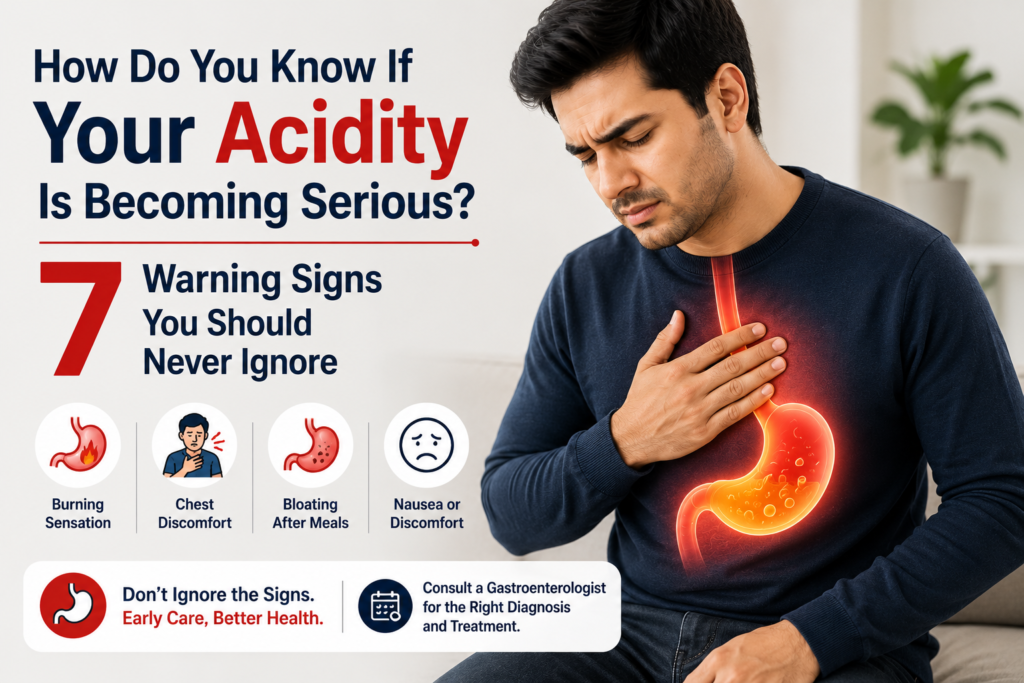
7 Warning Signs Your Acidity Is Becoming Serious
1. Heartburn That Happens Every Day Without Exception
Occasional heartburn after a heavy meal is normal. Daily heartburn — particularly when it occurs regardless of what you eat — is not. Furthermore, heartburn that wakes you at night, forces you to sleep with your head elevated, or makes you dread lying down after meals signals that your lower oesophageal sphincter has weakened significantly.
This pattern is the defining feature of GERD — and GERD left untreated for months or years is the primary driver of oesophageal damage progression. Additionally, studies consistently show that patients who treat daily heartburn with antacids alone — without addressing the underlying GERD — face a significantly higher risk of developing Barrett’s Oesophagus than those who receive proper diagnosis and treatment early.
Do not normalise daily heartburn. It is your oesophagus asking for help.
2. Antacids Stop Working — Or You Need More and More
When you first develop acid reflux, antacids work quickly and completely. However, as the underlying condition progresses, the same antacid dose produces diminishing relief — and eventually stops working altogether.
Needing to increase your antacid dose to achieve the same effect, or finding that even maximum doses only dull rather than eliminate your symptoms, strongly indicates that simple acid suppression can no longer manage what is happening in your digestive tract. Consequently, this escalating pattern signals a need for proper diagnosis — not a stronger antacid.
Moreover, long-term unsupervised antacid use carries its own risks — including magnesium depletion, rebound hyperacidity, and in the case of proton pump inhibitors, reduced B12 absorption and increased fracture risk over time.
3. Difficulty Swallowing Food or Liquids
Feeling food get stuck in your throat or chest while swallowing — a symptom called dysphagia — is one of the most serious warning signs associated with untreated acidity. This symptom never represents normal indigestion and always warrants an urgent gastroenterologist evaluation.
Dysphagia in the context of chronic acid reflux typically indicates one of two things. Either the oesophagus has developed a stricture — a narrowing caused by scar tissue from repeated acid damage — or the oesophageal lining has undergone the cellular changes of Barrett’s Oesophagus. Furthermore, in a smaller proportion of patients, dysphagia indicates an oesophageal growth that requires immediate investigation.
Additionally, if swallowing difficulty develops suddenly or worsens rapidly over days rather than weeks — treat this as an emergency rather than a routine appointment.
4. Unexplained Weight Loss
Losing weight without intentionally changing your diet or exercise routine — particularly in the context of ongoing digestive symptoms — is a combination that gastroenterologists treat as a red flag without exception.
Weight loss in this context occurs for two primary reasons. Either pain or discomfort is causing you to eat less without fully realising it, or the underlying condition affecting your digestive tract is impairing nutrient absorption. Moreover, unexplained weight loss combined with difficulty swallowing or persistent upper abdominal pain accelerates the urgency of investigation significantly.
Therefore, if you have lost more than three to four kilograms over the past two to three months without trying — and you are also experiencing ongoing digestive symptoms — do not delay seeking specialist evaluation.
5. Persistent Nausea or Vomiting
Occasional nausea after an unusually rich meal is completely understandable. However, nausea that occurs regularly — particularly in the morning, independent of meals, or as a persistent background sensation throughout the day — signals a digestive system under genuine stress.
Furthermore, vomiting that contains blood — whether bright red or the dark, coffee ground-like appearance of older blood — is a medical emergency that requires immediate attention. This finding indicates active bleeding in the upper digestive tract — most commonly from a gastric ulcer, oesophageal tear, or advanced oesophagitis.
Additionally, even without blood, persistent vomiting alongside chronic acidity suggests that the stomach or oesophagus may have developed structural damage that antacids are entirely unable to address.
6. Pain in the Chest or Upper Abdomen That Feels Different
Acid reflux typically produces a familiar burning sensation behind the breastbone. However, when the character of your pain changes — becoming sharper, more intense, radiating to your back or jaw, or occurring at rest rather than just after meals — this shift demands immediate medical evaluation.
Chest pain that resembles acidity can, in some cases, originate from the heart rather than the digestive tract. Consequently, any new chest pain — particularly pain accompanied by shortness of breath, sweating, or arm discomfort — requires emergency evaluation to rule out cardiac causes before attributing it to acid reflux.
Furthermore, a deep, gnawing pain in the upper central abdomen — especially one that wakes you between 2 and 4 AM, improves temporarily after eating, and then returns — strongly suggests a peptic ulcer rather than simple GERD. Peptic ulcers require specific treatment and can cause serious complications including bleeding and perforation if left unaddressed.
7. Blood in Stool or Noticeably Dark Stools
This is the warning sign that demands the most urgent response. Black, tarry stools — medically called melaena — almost always indicate bleeding from the upper digestive tract. The black colour occurs because blood from the stomach or oesophagus gets partially digested during its passage through the gut.
Bright red blood in stool suggests bleeding lower in the digestive tract. However, either finding in someone with chronic acidity or digestive symptoms requires same-day medical evaluation — not a wait-and-see approach.
Moreover, some patients notice that their stools have become progressively darker over several weeks without obvious bright blood. This gradual darkening can indicate slow, chronic bleeding from a gastric ulcer or oesophageal erosion — a finding that an endoscopy identifies and treats directly during the same procedure.
What Happens If You Keep Ignoring These Signs?
Many patients manage serious acidity for months or years with over-the-counter antacids — never investigating what is actually causing it. This approach carries real and progressive risks.
Untreated GERD causes permanent oesophageal scarring that leads to swallowing difficulty. Chronic H. pylori infection — which frequently coexists with severe acidity in India — significantly increases the lifetime risk of stomach ulcers and stomach cancer. Furthermore, Barrett’s Oesophagus — which develops silently from untreated GERD — carries a small but real risk of progressing to oesophageal cancer if not monitored and managed by a specialist.
Consequently, early investigation is always simpler, less expensive, and more effective than managing the complications of advanced disease.
What Does a Gastroenterologist Do to Investigate Serious Acidity?
Rather than simply suppressing acid further, a gastroenterologist identifies the exact cause and extent of damage through targeted investigation:
- Upper GI Endoscopy — directly visualises the oesophagus, stomach, and upper intestine. It identifies oesophagitis severity, Barrett’s changes, ulcers, and H. pylori simultaneously — in a single 15-minute procedure performed under mild sedation
- H. pylori breath test or stool antigen test — a non-invasive way to confirm or exclude bacterial infection driving chronic acidity
- 24-hour pH monitoring — measures actual acid levels in the oesophagus over a full day, confirming GERD severity and guiding treatment decisions
- Oesophageal manometry — assesses the function of the lower oesophageal sphincter for patients with severe or atypical reflux symptoms
Accurate diagnosis means targeted, effective treatment — rather than indefinite symptom suppression with escalating antacid doses.
Frequently Asked Questions
How do I know if my acidity is GERD or something more serious? GERD is diagnosed when acid reflux occurs at least twice a week consistently and begins to impact quality of life. Signs that something more serious may be developing include daily heartburn despite antacids, difficulty swallowing, unexplained weight loss, or any blood in stool. An endoscopy is the only reliable way to assess the extent of oesophageal damage and rule out more serious conditions.
Can chronic acidity cause cancer? Chronic untreated GERD can lead to Barrett’s Oesophagus — a pre-cancerous cellular change in the lower oesophagus. Barrett’s Oesophagus carries a small but real annual risk of progressing to oesophageal adenocarcinoma. Regular endoscopic monitoring and appropriate treatment significantly reduce this risk.
When should I see a gastroenterologist for acidity in Varanasi? See a gastroenterologist if your acidity occurs daily, antacids no longer provide adequate relief, you experience difficulty swallowing, you have lost weight unexpectedly, or you notice any blood in your stool or vomit. Dr. Shekhar Puri at Samarpan Gastro and Liver Clinic, Varanasi, specialises in diagnosing and treating the full range of acid-related digestive conditions.
Is an endoscopy necessary for acidity? Not for every patient — but an endoscopy is strongly recommended when acidity is daily and persistent, does not respond to medication, or is accompanied by any of the seven warning signs described in this guide. It is the only way to directly assess whether oesophageal damage, Barrett’s changes, ulcers, or H. pylori infection are present.
What is the difference between acidity and a stomach ulcer? Acidity causes a burning sensation behind the breastbone, typically after meals. A stomach ulcer produces a deeper, gnawing pain in the upper central abdomen — often between meals or at night — that temporarily improves after eating and then returns. An endoscopy distinguishes between the two reliably and guides the correct treatment for each condition.
Consult Dr. Shekhar Puri — Varanasi’s Trusted Gastroenterologist
Daily acidity deserves a proper diagnosis — not a permanent antacid prescription.
If you recognise any of the seven warning signs described above, or if your acidity has simply been getting worse rather than better over recent weeks or months — do not delay seeking specialist evaluation. The earlier a gastroenterologist assesses your symptoms, the simpler and more effective the treatment will be.
Dr. Shekhar Puri at Samarpan Gastro and Liver Clinic, Varanasi specialises in the complete diagnosis and treatment of acid-related disorders — from GERD and oesophagitis to Barrett’s Oesophagus, peptic ulcers, and H. pylori infection. With advanced endoscopy capabilities and a genuinely patient-centred approach, Dr. Puri provides clear answers and effective treatment plans tailored to each patient’s specific condition.
Book your appointment today via WhatsApp — because serious acidity deserves a serious answer.
According to the Indian Society of Gastroenterology, early endoscopic evaluation of persistent acid reflux symptoms significantly reduces the risk of oesophageal complications and improves long-term treatment outcomes — making timely specialist consultation one of the most impactful steps any chronic acidity patient can take.
⚠️ Medical Disclaimer: This blog is for general informational purposes only and does not constitute medical advice. Always consult a qualified doctor for diagnosis and personalised treatment.
