
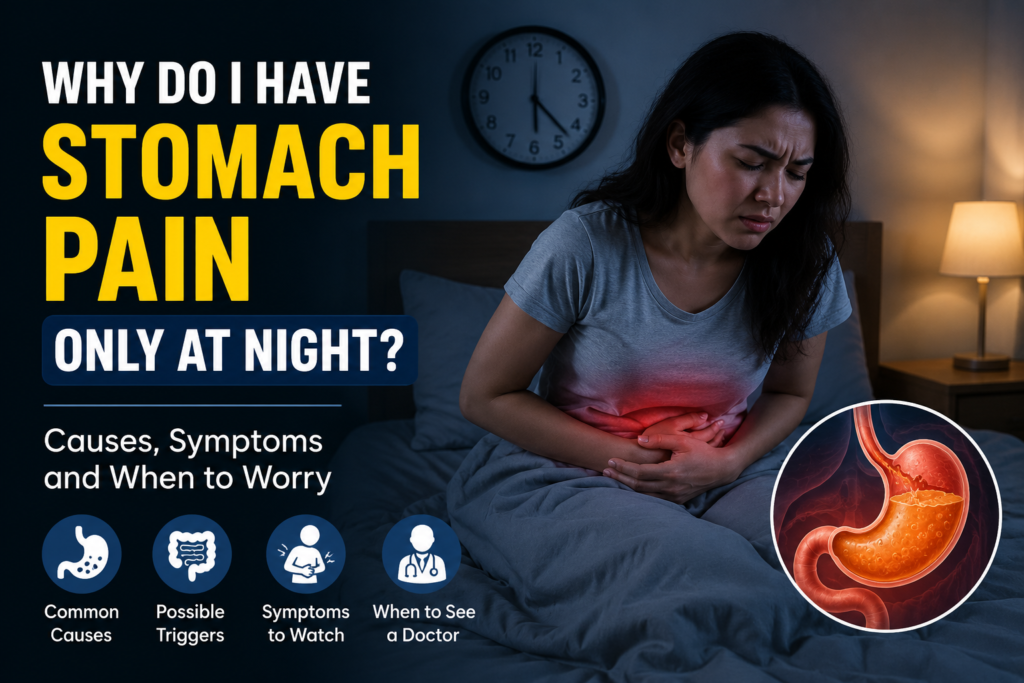
You sleep well for a few hours. Then a nagging, gnawing, or cramping pain in your stomach wakes you at 2 or 3 AM. During the day, you feel relatively fine. But every night — or most nights — the pain returns.
Stomach pain only at night is one of the most diagnostically significant patterns a gastroenterologist encounters. Moreover, the fact that pain occurs specifically during sleep — rather than after meals or during daily activity — tells doctors something important about the underlying cause.
This guide explains exactly why stomach pain occurs only at night, which digestive conditions produce this specific pattern, what warning signs accompany it, and when to seek specialist help.
Stomach pain only at night — particularly pain that wakes you from sleep — is one of the most important warning signs in gastroenterology. It most commonly indicates peptic ulcer disease, GERD, pancreatitis, IBS with nocturnal symptoms, or gallstone disease. Unlike functional digestive discomfort, pain that consistently wakes you from sleep almost always has a structural or inflammatory cause requiring gastroenterologist evaluation. Patients experiencing persistent digestive symptoms can consult a gastroenterologist for proper evaluation and treatment.
Why Nighttime Stomach Pain Is Different From Daytime Pain
Most digestive discomfort — bloating, mild acidity, post-meal heaviness — follows meals and activity. It occurs during the day, triggered by food or stress. It does not wake you from sleep.
Stomach pain that occurs only at night — particularly pain that wakes you from deep sleep — operates through completely different mechanisms. Moreover, the sleeping body changes its digestive environment significantly. Acid production follows a circadian rhythm — peaking between midnight and 2 AM in many people. Furthermore, the horizontal sleeping position removes gravity’s protective role against acid reflux. Consequently, conditions involving acid, inflammation, or obstruction produce their most intense symptoms precisely when most people are asleep.
Why “Waking Pain” Is a Red Flag
Pain that wakes a person from sleep is a clinical red flag across all medical specialities — not just gastroenterology. Moreover, truly functional conditions — IBS, stress-related discomfort, anxiety — rarely produce pain severe enough to disrupt sleep. Furthermore, the pain that wakes you at 2 AM has typically been building for hours during sleep without the distraction of daily activity masking it. Consequently, nocturnal stomach pain almost always warrants investigation rather than watchful waiting.
Symptoms Checklist — Does This Sound Like You?
Check the symptoms that apply to your experience:
☐ Stomach pain occurs specifically at night — often waking you from sleep
☐ Pain is minimal or absent during the daytime
☐ Pain typically occurs between midnight and 3 AM
☐ Eating something at night temporarily relieves the pain
☐ Pain improves briefly after eating but returns within hours
☐ Burning or gnawing quality to the pain — rather than sharp or colicky
☐ Upper right abdomen pain after fatty dinners in the evening
☐ Nausea accompanies the nighttime pain
☐ Loose stools or urgency to defecate at night
☐ Back pain radiates alongside the abdominal pain at night
If you checked 3 or more: Your symptoms suggest a structural digestive condition requiring gastroenterologist evaluation. Furthermore, any nocturnal pain that consistently wakes you from sleep warrants specialist assessment without delay.
8 Causes of Stomach Pain Only at Night
1. Peptic Ulcer Disease — The Most Classic Cause
Peptic ulcer disease is the most characteristic cause of stomach pain only at night. A peptic ulcer is an open sore on the stomach lining or the upper part of the small intestine — called the duodenum.
The pain from a duodenal ulcer follows a very specific pattern. It typically occurs when the stomach is empty — between meals and during overnight fasting. Moreover, acid contacts the raw ulcer surface without any food to buffer it — producing the characteristic gnawing or burning pain that wakes patients at 2 or 3 AM.
Furthermore, eating something — even a few biscuits or a glass of milk — temporarily neutralises the acid and relieves the pain. Consequently, patients with duodenal ulcers often discover that eating in the middle of the night provides relief — a pattern so characteristic that it points strongly toward peptic ulcer as the diagnosis.
H. Pylori’s Role in Nocturnal Ulcer Pain
H. pylori bacterial infection — extremely common in India — is the primary cause of most peptic ulcers. Moreover, this infection increases acid production significantly while damaging the protective stomach lining. Furthermore, the resulting ulcers are most painful during the overnight fasting period when acid production peaks and no food buffers it. Consequently, treating H. pylori with a targeted antibiotic course typically resolves both the infection and the associated nocturnal pain within weeks.
2. Gallstone Disease and Biliary Colic
Gallstones produce a very specific type of nighttime pain called biliary colic. A gallstone temporarily blocks the bile duct — triggering a powerful muscular spasm that produces severe, cramping pain in the upper right abdomen.
Moreover, biliary colic characteristically occurs at night — particularly two to four hours after a fatty or heavy dinner. Fat triggers bile release — and bile movement through the ducts can dislodge stones that then block the duct opening. Furthermore, the pain builds rapidly to a peak over 30 to 60 minutes — then gradually subsides over several hours.
Consequently, recurring nighttime pain in the upper right abdomen after heavy evening meals strongly suggests gallstone disease — and an abdominal ultrasound confirms the diagnosis reliably.
3. GERD and Nocturnal Acid Reflux
Gastroesophageal Reflux Disease produces nighttime symptoms through a clear mechanism. During sleep, saliva production drops — reducing the natural acid buffer that protects the oesophagus during the day. Moreover, the horizontal sleeping position allows acid to pool in the oesophagus rather than draining back into the stomach by gravity.
Furthermore, acid production peaks between midnight and 2 AM in many individuals — coinciding precisely with the period of deepest sleep. Consequently, GERD patients often experience their worst symptoms as burning upper abdominal or chest pain that wakes them from sleep — a pattern they may not connect to acid reflux if they do not experience typical daytime heartburn.
4. Pancreatitis — Acute and Chronic
Pancreatitis — inflammation of the pancreas — produces a distinctive pain pattern that worsens dramatically when lying flat. The pancreas sits behind the stomach — and lying down increases pressure on the inflamed organ.
Moreover, patients with pancreatitis instinctively lean forward or sit up to relieve their pain — because this position reduces pancreatic pressure. Furthermore, nighttime pain from pancreatitis typically radiates through to the back — a characteristic feature that distinguishes it from most other causes of nocturnal abdominal pain.
Consequently, any stomach pain only at night that radiates to the back — particularly in someone with a history of alcohol use or gallstones — requires urgent investigation for pancreatitis.
5. Irritable Bowel Syndrome With Nocturnal Symptoms
IBS typically produces functional pain during the day — related to meals, stress, and bowel habit changes. However, a subset of IBS patients experience nocturnal symptoms — including cramping, urgency, and loose stools that wake them from sleep.
Moreover, nocturnal IBS symptoms are important because they raise the possibility of a more serious underlying condition. Furthermore, true organic diseases — including inflammatory bowel disease and colorectal cancer — more commonly produce nocturnal symptoms than classic functional IBS. Consequently, any IBS patient experiencing consistent nocturnal pain should undergo investigation to exclude structural disease before attributing symptoms purely to IBS.
6. Inflammatory Bowel Disease (IBD)
Crohn’s disease and ulcerative colitis — collectively called Inflammatory Bowel Disease — frequently produce nocturnal abdominal pain, cramping, and urgent diarrhoea that wake patients from sleep.
Moreover, IBD-related nocturnal symptoms indicate active disease inflammation — as opposed to remission periods when symptoms are typically minimal. Furthermore, blood in stool alongside nocturnal pain strongly suggests active IBD flare requiring prompt specialist evaluation.
Consequently, any patient with recurrent nocturnal abdominal pain and altered bowel habits — particularly with blood or mucus in stool — requires colonoscopy to assess for IBD.
7. Intestinal Obstruction or Adhesions
Partial intestinal obstruction — from adhesions after previous abdominal surgery, hernias, or tumours — can produce intermittent cramping pain that worsens at night. The reduced gut motility during sleep allows gas and fluid to accumulate behind a partial obstruction — producing increasingly intense colicky pain.
Moreover, obstruction-related pain is typically colicky — coming in waves — rather than constant. Furthermore, it is often accompanied by bloating, nausea, and reduced or absent bowel movements. Consequently, any patient with previous abdominal surgery experiencing recurrent nocturnal cramping pain should specifically mention this history when seeking gastroenterologist evaluation.
8. Liver and Pancreatic Conditions
Advanced liver disease — including cirrhosis and hepatocellular carcinoma — can produce nighttime upper right abdominal pain from liver capsule stretching as the organ enlarges. Moreover, hepatitis — particularly acute hepatitis — produces right upper abdominal discomfort that often intensifies at night.
Furthermore, pancreatic cancer — though less common — characteristically produces severe nocturnal back pain that radiates to the abdomen. Consequently, any new nocturnal pain associated with jaundice, dark urine, pale stools, or significant weight loss requires urgent investigation for hepatobiliary or pancreatic pathology.
Myth vs Fact — Nighttime Stomach Pain
| 🔴 Myth | 🟢 Fact |
|---|---|
| “Nighttime stomach pain is just stress or anxiety” | Pain that consistently wakes you from sleep almost never has a purely psychological cause |
| “Eating at night causes stomach pain at night” | Nighttime pain from peptic ulcer actually improves briefly after eating |
| “If I can sleep through it sometimes, it is not serious” | Intermittent nocturnal pain is equally significant — peptic ulcers and gallstones produce variable intensity |
| “Antacids will fix nighttime stomach pain permanently” | Antacids suppress symptoms — they do not treat ulcers, gallstones, or pancreatitis |
| “Only elderly people get ulcers” | Peptic ulcer and H. pylori infection affect young Indians in their 20s and 30s increasingly |
| “Nighttime pain always means cancer” | Most nocturnal stomach pain results from peptic ulcer, gallstones, or GERD — not cancer |
People Also Ask
Why do I get stomach pain only at night and not during the day?
Stomach pain occurring only at night reflects specific nocturnal changes — acid production peaks between midnight and 2 AM, lying down increases acid reflux and pancreatic pressure, and the empty fasting stomach exposes ulcer surfaces to undiluted acid. Moreover, daytime activity and food intake mask symptoms that the quiet of sleep allows you to notice fully.
Is stomach pain that wakes me from sleep serious?
Yes — pain that consistently wakes you from sleep is a clinical red flag. Unlike functional digestive discomfort, nocturnal waking pain almost always indicates a structural or inflammatory condition — peptic ulcer, gallstones, pancreatitis, IBD, or liver disease. Patients experiencing this pattern should consult a gastroenterologist promptly rather than self-managing with antacids.
Why does eating something at night relieve my stomach pain?
Pain that relieves with eating — even briefly — is the classic pattern of duodenal peptic ulcer disease. Food temporarily neutralises stomach acid — relieving the burning contact between acid and the raw ulcer surface. This specific pattern is so characteristic that it strongly points toward peptic ulcer as the diagnosis, even before any investigation.
Can gallstones cause stomach pain only at night?
Yes — biliary colic from gallstones characteristically occurs at night, typically two to four hours after a fatty evening meal. Fat triggers bile release and movement — which can dislodge stones into the bile duct. The resulting cramping pain in the upper right abdomen can be severe and last several hours before resolving.
What tests diagnose the cause of nighttime stomach pain?
An upper GI endoscopy directly identifies peptic ulcers, gastritis, and GERD damage. An abdominal ultrasound detects gallstones and liver abnormalities. Blood tests including H. pylori testing, liver function tests, amylase, and lipase assess for infection, liver disease, and pancreatitis. A colonoscopy evaluates the large intestine when IBD or colorectal disease is suspected.
When Should You See a Gastroenterologist?
Nighttime stomach pain that wakes you from sleep always warrants specialist evaluation. However, see a gastroenterologist urgently if your nighttime pain:
- Occurs every night or most nights consistently
- Is severe enough to prevent you from returning to sleep
- Radiates to your back — suggesting pancreatic involvement
- Accompanies fever, jaundice, or dark urine
- Comes with blood in stool or vomiting blood
- Produces significant unexplained weight loss
- Occurs alongside right upper abdominal pain after fatty meals
- Has worsened progressively over recent weeks
Furthermore, patients experiencing persistent digestive symptoms can consult a gastroenterologist for proper evaluation and treatment — because most conditions causing nighttime stomach pain respond very well to treatment when identified correctly and early.
FAQs
What causes stomach pain only at night?
Stomach pain occurring only at night most commonly results from peptic ulcer disease — where acid contacts a raw ulcer during the overnight fasting period. Other common causes include gallstone biliary colic after fatty evening meals, nocturnal GERD, pancreatitis, inflammatory bowel disease, and liver or pancreatic conditions. The specific timing, character, and accompanying symptoms help identify the exact cause.
How do I relieve stomach pain at night?
For immediate temporary relief — sit upright, take a prescribed antacid, or eat a small amount of bland food if peptic ulcer is suspected. However, these measures manage symptoms rather than treating the underlying condition. A gastroenterologist identifies and treats the specific cause — providing lasting relief rather than indefinite nocturnal symptom management.
Can stress cause stomach pain only at night?
Stress rarely produces pain severe enough to wake a person from sleep. While stress worsens existing conditions like IBS and GERD, consistent nocturnal waking pain almost always has a structural or inflammatory cause — not a purely psychological one. Furthermore, assuming stress is the cause without investigation delays diagnosis of treatable conditions.
Is nighttime stomach pain a sign of ulcer?
The classic peptic ulcer pain pattern is pain that occurs specifically when the stomach is empty — at night and between meals — and improves briefly after eating. Furthermore, a gnawing or burning quality to the pain combined with this empty-stomach timing strongly suggests duodenal ulcer. An upper GI endoscopy confirms the diagnosis.
Which specialist treats nighttime stomach pain in Varanasi?
A gastroenterologist is the right specialist for persistent nocturnal stomach pain. Dr. Shekhar Puri at Samarpan Gastro and Liver Clinic, Varanasi, diagnoses and treats peptic ulcer, gallstone disease, GERD, pancreatitis, IBD, and the complete range of digestive and liver conditions causing nighttime abdominal pain — with advanced endoscopy and comprehensive diagnostic services under one roof.
Consult Dr. Shekhar Puri — Varanasi’s Trusted Gastroenterologist
Stomach pain only at night that wakes you from sleep is your body’s most urgent digestive signal. It deserves a proper evaluation — not another antacid and another restless night.
Most conditions causing nighttime stomach pain are highly treatable when identified correctly. Moreover, peptic ulcers heal completely with appropriate treatment. Gallstones can be managed or removed. Pancreatitis responds to targeted intervention. The key is identifying the specific cause — which requires specialist evaluation and the right investigations.
Dr. Shekhar Puri at Samarpan Gastro and Liver Clinic, Varanasi specialises in diagnosing and treating peptic ulcer, pancreatitis, liver cirrhosis, hepatitis, stomach infection, and the complete range of digestive disorders causing nocturnal abdominal pain. With advanced endoscopy and comprehensive diagnostic services under one roof, Dr. Puri provides clear answers and effective, personalised treatment.
Patients experiencing persistent digestive symptoms can consult a gastroenterologist for proper evaluation and treatment — and the earlier you seek this, the simpler and more effective your treatment will be.
Book your appointment today via WhatsApp — because waking up with stomach pain every night deserves a real diagnosis, not another sleepless morning.
According to the Indian Society of Gastroenterology, peptic ulcer disease and biliary colic remain among the most prevalent — and most commonly delayed in diagnosis — causes of nocturnal abdominal pain in India, with many patients self-managing with antacids for months before appropriate specialist evaluation is sought.
⚠️ Medical Disclaimer: This blog is for general informational purposes only and does not constitute medical advice. Always consult a qualified doctor for diagnosis and personalised treatment.
